Journal of Fuzzy Systems and Control, Vol. 1, No 3, 2023 |
Frozen Base Gateway Discovery Algorithm for Mobile Ad-Hock Network with Internet Connectivity Using AODV+ Routing Algorithm
Atinkut Molla Mekonnen 1, Tsehay Admassu Assegie 2,* , Towfik Jemal 3
1 Department of Information Technology, Injibara University, Injibara, Ethiopia
2 Department of Computer Science, Injibara University, Injibara, Ethiopia
3 Department of Electrical and Computer Engineering, Werabe University, Werabe, Ethiopia
Email: 1 atinkutmolla2012@email.com, 2 tsehayadmassu2006@gmail.com
*Corresponding Author
Abstract—A mobile ad-hoc network (MANET) is a self-organized, auto-configured network and the mobile nodes have been free to move. To enable the MANET to connect to the internet it uses an intermediate bridge called a gateway. The MANET and the internet gateway is a heterogeneous network, which needs a gateway discovery. There are three types of gateway discovery mechanisms: proactive, reactive, and hybrid gateway discovery mechanism. The main challenge in the integration of the MANET and the Internet is, that there are high link disconnection results from node mobility and limited energy. In addition link disconnection, packet drop, and end-to-end delay. This study examines the impact of node mobility and energy in the frozen path from the source node to the destination node of MANET In this study, the Ad-hoc on-demand distance vector routing (AODV) routing protocol is used and modified to examine the gateway selection for MANET and the Internet. Moreover, the AODV+ control message RREQ and RREP and the routing table are improved to store the energy factor, path queue length, and frozen factor of the path. The proposed gateway discovery algorithm is known as frozen-based gateway AODV+ (F_AODV+), The stability factors of the path from the source node to the gateway, are calculated using a simple additive weighting method of the energy factor, average path queue node, and the path with the Maximum energy factor and minimum queue length is the more Frozen to select Frozen gateway from the source node to distension node.
Keywords—Frozen-based; AODV+; Gateway Discovery; MANET
A MANET is a self-organized, auto-configured network and the mobile nodes are free to move. To enable the MANET to connect to the internet it uses an intermediate bridge called a gateway. The MANET and the internet gateway is a heterogeneous network, which needs a gateway discovery mechanism. The second one is an infrastructure-less network known as MANET, which is a wireless mobile node dynamically establishing a temporary network without the use of any existing infrastructure network [1]. The main challenges of MANET are the network has limited wireless transmission range, packet loss due to a transmission error, node mobility, limited energy, and application domain [2].
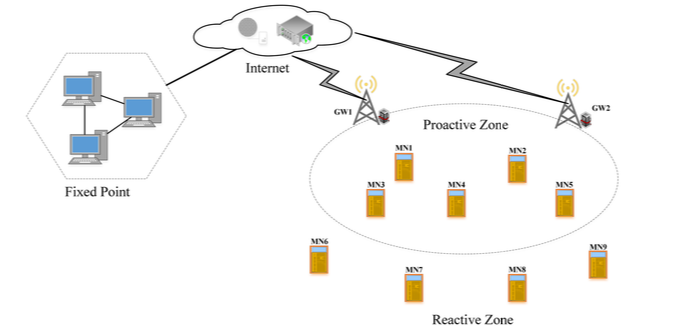
The first one is infrastructure and the second is an infrastructure-less network known as MANET, which is a wireless mobile node dynamically establishing a temporary network without the use of any existing infrastructure network [3]. The main challenges of MANET are the network has limited wireless transmission range, packet loss due to a transmission error, node mobility, limited energy, and application domain [4]. Architecture of Internet and MANET Integration shown in Fig. 1.
In communication, MANET nodes use different routing protocols. The routing protocols are used to discover the path and to move information from source to destination. However, the main challenge in integrating MANET and the internet is due to architecture divergence [5].
The wireless network begins with the integration of personal computing, cellular technology, and the internet [13]. This is due to the combination of communication and computing which allows information access anytime and anywhere [6]. There are two types of wireless networks, which are known, as Cellular networks and wireless there are two types of wireless networks [7], which are known as cellular networks and wireless ad-hoc networks defined in Table 1.
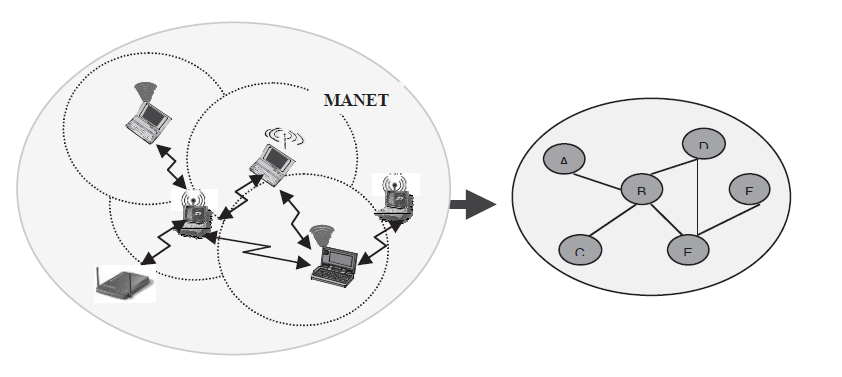
The communication among mobile networks (MN)in the MANET is limited to a certain transmission range [9]. However, if the two MNs are not within the communication range, they use two or more intermediate MNs to deliver the information from source to destination [14], [15]. Moreover, it is appropriate to call such networks “multi-hop wireless ad hoc networks”.
As shown in Fig. 2, in a Multi-hop network forwarded packet from source MN to destination MN is done by intermediate nodes (hop by hop) [10]. For example, if we need to send data from A to F, we have to use path A-B-E-F or A-B-D-E-F. This forwarding process is known as routing [16], [17]. As it has been stated in the previous chapter, node energy and mobility have the most constraints in MANET. The main goal of routing is to minimal control overhead, to minimal process overhead, to have multi-hop routing capability, dynamic topology maintenance and to have successful routing establishment between the pair of nodes [11]. Routing protocols have been classified as Proactive, Reactive, and hybrid routing protocols based on their route discovery mechanism [12].
Cellular Network | MANET |
Infrastructure network | Infrastructure-less network |
Fixed, known base station | No base station and rapid deployment |
Static network topology | Dynamic network topologies with multi-hop |
Frozen connectivity | Connectivity affected by noise and interference |
Needs planning for base station and network infrastructure installing | automatically adapts to topology changes |
Need cost and time to setup | Cost-effective and Less setup time |
The proactive routing protocol is also called the driven routing protocol. In this routing protocol, each node in a network maintains routes to all destinations [8]. Reactive routing protocol, in this type of routing protocol, each node in a network discovers or maintains a route when a connection is needed, and the protocol floods a control message by broadcast during route discovery. The AODV routing algorithm is a self-organizing routing protocol used to maintain ad-hoc networks [18], [19]. In this type of routing protocol, the source MN establishes the route request only if it is desired to communicate with other MN in the MANET and does not require maintaining routes to destinations to which it is not in active communication. AODV requires each MN to maintain a route table to store next-hop routing information for the destination MN. Each routing table entry follows up the routing process by storing certain parameters.
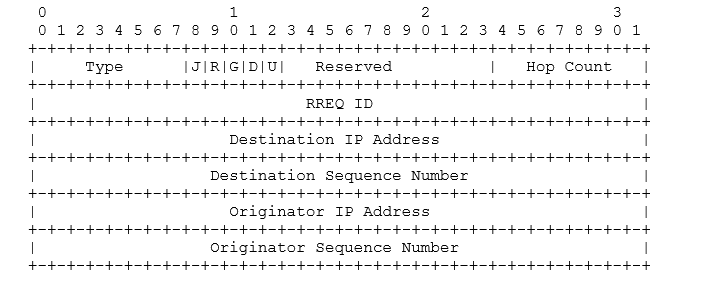
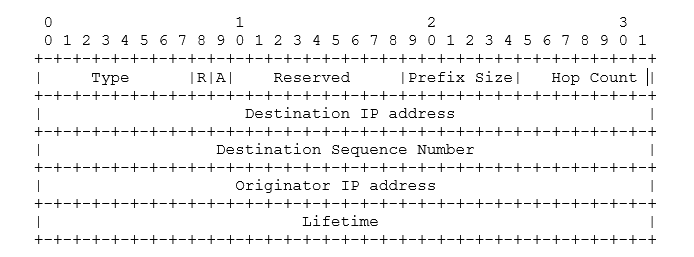
When a route is not available in the route table for the destination, an originating node (source node) broadcasts a route request packet (RREQ) all over the network [20]. RREQ message has the following fields and it shows the RREQ message. The destination node’s IP address, the source’s IP address, destination sequence number, and current sequence number [21]. RREQ message format shown in Table 2 and Table 3.
When an RREQ reaches the destination MN, the node creates a reverse message called RREP. The RREP message format contains the source node’s IP address, the destination node’s IP address, and the destination’s sequence number. In addition, the hop count field in the RREP is set equal to the number of nodes from the destination [22].
The RERR message is generated whenever a link failure occurs, and destinations become unreachable due to the loss of link from some of the node’s neighbors [23]. The node broadcasts the RERR message to notify that there is a link failure within the path. The RERR message contains the IP address of each destination node, which has become unreachable due to the link break. In AODV, route creation between two nodes is done based on the Route Discovery and Route Maintenance Process [24].
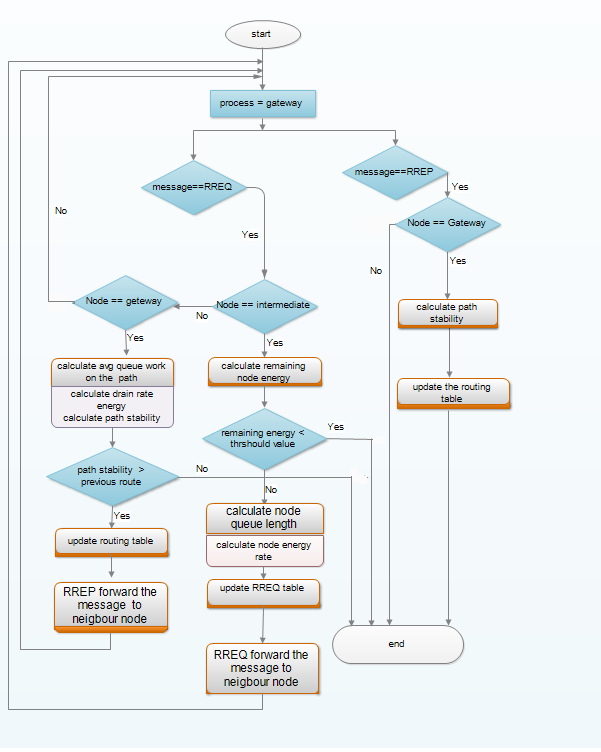
Since MANET is a portable and easily inconsistent network, its route is not as frozen as the wired network. This study analyses the real situation and requirement of MANET nodes accessing the Internet and proposes a gateway discovery scheme used in this situation. The gateway discovery and selection scheme considers mobility and energy-consuming factors, node queue length, and path hop count to make a route to the Internet more reliable and get better performance. Therefore, the protocol needs a modification to support the connectivity.
The new RREQ_I packet was modified by adding the following parameters: - energy factor (measures the residual energy on the path), node queue length which indicates the distance of nodes of the path, and the path Frozen factor. The RREQ_I represents the source request for Internet connectivity. This Internet connectivity request (RREQ_I) also holds the information needed for the finding of the optimal and frozen path to connect to the Internet. The newly proposed gateway discovery schema adds the node queue length and energy factor the frozen factor finds by aggregating the energy factor, frozen factor, and the packet occupancy of the path.
As discussed in the previous section, the main reason for the performance degradation of the gateway discovery is the disconnection of the route to the internet This failure of the GW route occurs as an MN which is part of the active route, goes out of the reach of the neighboring node on the same route or the node lifeless because of energy depletes. When the GW route fails, packets that are being exchanged with the internet through the GW are dropped. Frozen algorithm work shown in Fig. 3.
In this study, an algorithm for integration of MANET with the internet implemented by Alihamidian [8] is modified. The source node is using the traffic connection to the wired node using the gateway. In this simulation, the MN that has a traffic connection to the node in the fixed network is communicating through the gateway. The AODV+ protocol is written in C++ and the Tcl code used to configure the MN in MANET is modified.
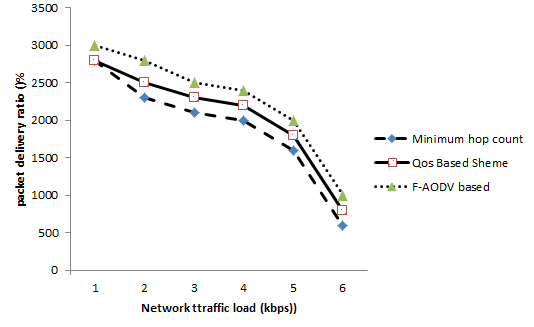
The simulation consists of 1000 mobile nodes, two fixed hosts, and two gateways. The nodes in each scenario are distributed randomly in the area with 800-meter length and 800-meter width. All the fixed links have a bandwidth of 100 Mbps. Each wireless transmitter has a radio range of 250 m. Each simulation node has the speed of from 1, 2, 3, 4, 5 m/s. Packet delivery ratio shown in Fig. 4.
The proposed Frozen gateway discovery has about a 93% success rate in the packet delivery on the gateways when compared with the hop count-based gateway discovery which is 74%, the average in all given number of nodes, pause time, and speed scenarios. This shows that the proposed gateway discovery mechanism has selected the frozen route over the hop counts based on AODV.
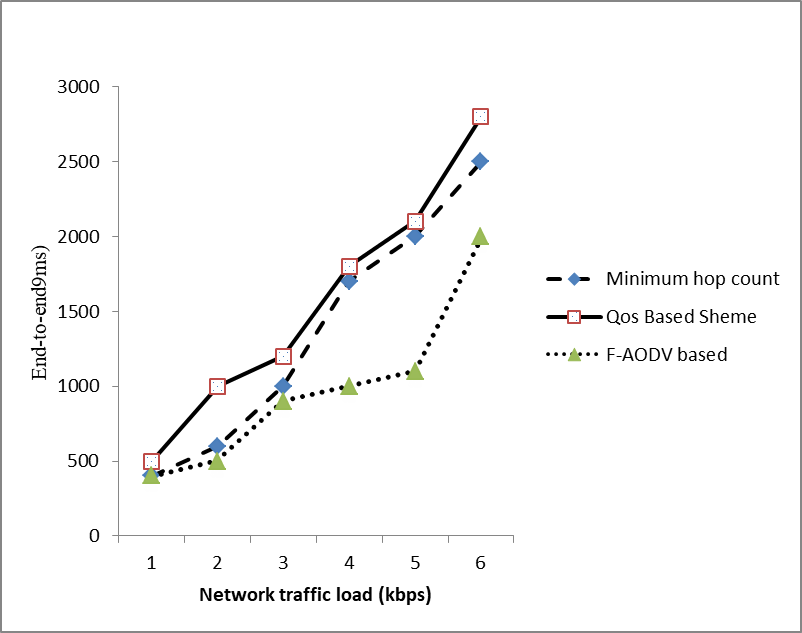
To calculate the average end-to-end delay, the time taken for each packet to travel from the source node to the destination node is recorded. The total delay is then divided by the number of packets sent to obtain the average delay. Several techniques can be used to reduce the average end-to-end delay in MANETs, such as using efficient routing protocols, optimizing network topology, and reducing interference between nodes. Equation (1) refers to the formula used for calculating average end-to-end delay. Where Ts is the packet send time, Tr is the packet received time and the Pt is total packet generated. Average end-to-end delay shown in Fig. 5.
(1) |
As Fig. 5, the average of an End-to-End delay is less in a frozen gateway than in minimum Hop count and QOS-based scheme gateway discovery in AODV. The reason is that the periodic RREQ_I sent by the MN allows the nodes to get the fresh and frozen path. In minimum hop count-based and QOS-based scheme AODV gateway discovery, it only considers the number of minimum hops and QOS-based to deliver the packet from source to destination. However, the algorithm isn’t aware of the level of energy of the nodes and its link failure because of node mobility. When the node speed is maximized in all scenarios pause time proportionally the end-to-end delay is also maximized, the reason for the increase in the delay is the probability of change path routing is high when MN has high speed. The average of the End-to-End delay in all simulation cases in this simulation area the new proposed algorithm has better achievement with 0.253 seconds when compared with the existing algorithm with 0.289 seconds.
As discussed in previous sections, node-limited energy and its movement have an impact on the link disconnection. The disconnection time is the time when source MN is disconnected from error occurring until finds another route to the gateway [19], [25]. The percentage of the disconnection time is the time that the source node used for error handling, and for discovering a new route to the gateway from the total simulation. Equation (2) is used to calculate the disconnection time of a node through the simulation.
| (2) |
Where: Discontinued is Percentage of disconnection time in the simulation, K is Number of disconnections in simulation, E is Number of errors that occur in total simulation time, ErrorHr is Error processing time, Discontimesn is Disconnection time.
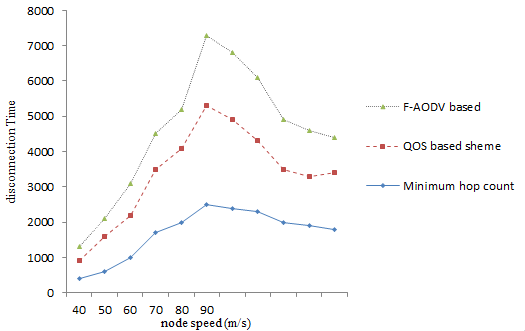
The result behind node unfrozen is node disconnection as shown in Fig. 6. However, in this study, the nodes are distributed randomly and the node density is affected by the node disconnection. As can be seen in Fig. 6 the new proposed Frozen gateway discovery algorithm has a small time spent being disconnected from the network. Moreover, in the simulation with a time of 50 seconds and 10 m/s speed about 7% of its time is disconnected, hence, because of its slow speed after MN disconnected from the network maintaining another route needs more time.
However, when comparing the frozen gateway discovery with the existing minimum hop count based and QOS based has better performance in maintaining the route after being disconnected, and the new proposed gateway discovery has minimum disconnection time which is 0.995% from the total simulation time. However, the minimum hop counts based on AODV and QOS-based AODV gateway discovery have spent about 1.521% of the total simulation time.
In this study, an algorithm for frozen gateway discovery is proposed. The performance evaluation of the frozen gateway discovery algorithm is performed by using a simulation area of 800 m2 and using three metrics. The pause time of the random mobility model and the node speed are directly related to the movement of MNs in the simulation area and hence it is considered for the scenario design. The density of nodes is also another factor considered in the simulation. The nodes can easily move outside the radio range of each other and cause frequent GW route failures. In the simulation, to show the effect of mobility, different speed scenario is tested. In the gateway discovery, the stability of the route is measured by finding the intermediate node's remaining energy (to find the energy factor of the path), hop count node queue load, and energy drain rate of nodes in the routing path. In addition, by the smallest frozen factor, value finds by calculating the energy factor, total path queue, drain rate, and hop count it selects the route path.
Atinkut Molla Mekonnen, Frozen Base Gateway Discovery Algorithm for Mobile Ad-Hock Network with Internet Connectivity Using AODV+ Routing Algorithm