Journal of Fuzzy Systems and Control, Vol. 2, No 3, 2024 |
Wind Power Forecasting using Type-2 Fuzzy Control and its Optimization based on Artificial Neural Network for Small Scale Wind Power
Arunava Chatterjee *
Department of Electrical Engineering, Raghunathpur Government Polytechnic, Purulia, W. B., India
Email: arunava7.ju@gmail.com
*Corresponding Author
Abstract—Improving the efficiency and economic feasibility of variable renewable resources, wind speed forecasting can improve the quality of wind energy generation. By using the properties of wind-related factors, this work provides a new model for wind energy forecasting for electrical power generation at an onshore location in India. The model, which employs an Interval Type-2 fuzzy logic system (IT2FS), takes inputs of wind features and forecasts wind power. Further, an artificial neural network (ANN) is chosen as the adjustment model for optimization in the architecture. The neural network begins evaluating its performance using a different number of hidden-layer neurons. The ANN-based hybrid model outperforms other models according to comparisons drawn from statistical indices. The usage of this adjustment model of forecasting is shown to be quite helpful in predicting the wind power for driving fractional kW loads using wind-based generation techniques.
Keywords—Adjustment Model; Artificial Neural Network (ANN); Forecasting; Interval Type-2 Fuzzy Logic System (IT2FS); Wind Power
Global reliance on renewable energy sources, such as wind, sun, ocean, geothermal, biomass, and geothermal power, is a result of growing energy demands and dwindling fossil fuel supplies. These renewable energy sources serve as a backup for supplying the enormous demand of the global populace [1][2]. Among these, wind energy is one of the most highly regarded, promising, and advantageous power resources due to its abundant availability on Earth. Given the current situation, where demand for fossil fuels is growing more quickly, a transition toward renewable energies is necessary. This pushes technology to develop novel approaches to renewable energy. As a result, wind power forecasting is now one of the burgeoning areas of study primarily in electrical engineering. The creation of algorithms and related tools for wind power forecasting is the focus of several academics and researchers [3][4]. Many countries have set high standards for increasing the amount of renewable energy generated to be integrated into the grid, with wind energy projected to play a large role in achieving these targets. However, at deeper levels, it is observed that there is intrinsic fluctuation and uncertainty in wind power generation, which makes it difficult to integrate wind power with the grid [5]. Because wind energy generation depends on wind velocity, which is a highly unpredictable natural phenomenon, it is extremely uncertain. Less money will be spent system-balancing if these forecasting techniques are accurate in estimating the amount of wind power generated in the future. Significant savings for the wind farm's owners are possible in the case of large windmill farms with large-scale wind power output, which significantly raises the system's total efficiency [6][7]. The basic issue with these power systems is that because wind energy is so unpredictable, the operators cannot forecast when it will be generated. These innate qualities have an impact on the technical aspects of wind power systems and how well they are planned and run. Data regarding anticipated wind energy generation at a certain time interval can be provided by wind energy forecast [8].
Diverse methods for predicting wind power can be broadly classified into three groups. The first classification is based on a physical approach to meteorology, in which several physical elements related to the model's construction must be considered [9]. These factors include the height of the hub, temperature, terrain quality, roughness of the surface, and humidity. The second strategy, known as the statistical strategy, uses historical data sets to determine the link between the input and output variables of the wind power generating system [10]. The autocorrelation and cross-correlation functions are used to forecast wind power. Physical methods have advantages in large-scale forecasting and long-term prediction, while statistical methods are found to be good in the short term. As a result, researchers are focusing on a hybrid method that combines both physical and statistical methods in order to improve forecasting accuracy over time [11]. This is the third category. Based on the input factors, statistical and hybrid approaches can be used to do numerical weather forecasts, such as wind speed prediction.
Of all the schemes proposed for wind power prediction, none of them predicts wind power for small-scale wind power generation schemes [12]-[16]. This paper presents wind power prediction for such a small-scale isolated generation system typically supplying power for fractional kW generation [17][18] or hybrid schemes [19]. However, for such schemes, complexity is avoided in control to reduce system costs. Prediction of wind can still be used for reducing the system cost of generation effectively [20]-[25]. The proposed scheme utilizes the Interval Type-2 Fuzzy Inference System (IT2FS) for predicting wind power availability [26][27]. Further, an adjustment model is presented to optimize the predicted output using artificial neural network (ANN) architecture. This has the advantage that the ANN serves as an optimizer that refines the output of the Type-2 Fuzzy System. By learning the residual errors or fine-tuning the fuzzy outputs, the ANN can significantly enhance prediction accuracy, resulting in a robust system that leverages the uncertainty handling of fuzzy logic and the learning power of neural networks.
The proposed methodology is shown in Fig. 1 and it is described in detail in Section II. Further in Section III, the IT2FS rule base creation is detailed. The results and discussions are presented in Section IV. The conclusions and future scope of this research are presented in Section V.
In the proposed setup of prediction of wind power, the model used is an adjustment model where the Fuzzy outputs are adjusted using the ANN architecture. Fuzzy logic-based wind power prediction offers a flexible and interpretable approach to capturing the complex relationships between input variables and wind power output, making it valuable for renewable energy forecasting applications. Here, interval type-2 fuzzy logic system (IT2FS)-based wind power prediction is employed. Overall, fuzzy logic-based wind power prediction typically involves the following steps:
Data Collection: The first step is to collect historical data related to wind speed, direction, temperature, pressure, and power output from wind turbines. This data is crucial for training and validating the fuzzy logic model.
Feature Selection: Relevant features are selected as input variables for the fuzzy model. These features play a key role in determining wind power output.
Fuzzy Rule Base Creation: A fuzzy rule base is developed based on expert knowledge or data-driven methods. This rule base contains a set of linguistic rules that map input variables to output predictions. Designing this step is very important in obtaining the desired output.
Fuzzification: In this step, discrete input values are converted into fuzzy sets using membership functions. Fuzzy sets represent the degree of membership of an input value to different linguistic terms.
Fuzzy Inference: Using the fuzzy rule base and fuzzified input values, the fuzzy inference engine determines the degree to which each rule is satisfied. This process generates fuzzy output sets representing predicted power output levels.
Defuzzification: The final step involves converting fuzzy output sets back into crisp values using defuzzification methods such as centroid, mean of maxima, or weighted average. This produces a single numerical prediction for wind power output.
Model Evaluation and Validation: The fuzzy logic model is evaluated and validated using historical data not used during training. Performance metrics are often used to assess the accuracy of the predictions.
Finally, other intelligent techniques may be adopted to optimize the obtained results. This step is the adjustment model.
Optimizing the predicted output from a Type-2 Fuzzy System using an Artificial Neural Network (ANN) involves combining the strengths of both approaches: the ability of Type-2 Fuzzy Logic to handle uncertainty and the powerful learning capabilities of ANN.
These steps are further discussed in detail according to the problem chosen:
Data Collection: Historical data related to wind power generation is collected from NASA, USA's worldwide energy resource (power) database [28]. This includes variables such as wind speed, direction, temperature, pressure, and power output from wind turbines. The data is typically collected over a year period to capture variations in weather conditions and their impact on wind power generation.
Feature Selection: Relevant features are selected based on their influence on wind power generation. The features include wind speed, wind direction, temperature, and atmospheric pressure. These features serve as input variables for the fuzzy logic model and are crucial for making accurate predictions.
Fuzzy Rule Base Creation: A fuzzy rule base is developed either through expert knowledge or data-driven methods. Expert knowledge involves eliciting linguistic rules from domain experts, such as “If wind speed is high and temperature is low, then predict high power output.”
Data-driven methods involve using machine learning techniques to derive fuzzy rules from historical data, such as clustering algorithms or rule induction algorithms. In this problem, the former method is used.
Fuzzification: Fuzzification is the process of converting crisp input values (e.g., wind speed in meters per second) into fuzzy sets using membership functions. Membership functions define the degree of membership of an input value to different linguistic terms (e.g., low, medium, high) within the fuzzy sets.
Fuzzy Inference: The fuzzy inference engine applies the fuzzy rule base to fuzzified input values to determine the degree to which each rule is satisfied. Fuzzy logic operators such as AND, OR, and NOT are used to combine the fuzzy sets and evaluate the rules. This process generates fuzzy output sets representing predicted power output levels based on the input variables.
Defuzzification: Defuzzification converts fuzzy output sets back into crisp values, providing a single numerical prediction for wind power output. Common defuzzification methods include centroid (calculating the center of gravity of the fuzzy output sets), mean of maxima (calculating the average of the highest values), or weighted average (taking a weighted average based on the degree of membership).
Model Evaluation and Validation: The fuzzy logic model after adjustment is evaluated and validated using historical data that was not used during training. Performance metrics such as mean absolute error (MAE), root mean square error (RMSE) and mean absolute percentage error (MAPE) are used to assess the accuracy of the predictions. The model is fine-tuned or adjusted based on the validation results to improve prediction accuracy using ANN.
The ANN takes the IT2FS predicted output and other input features to produce a refined, optimized predicted output. This approach is often more effective since it leverages the uncertainty-handling capability of the IT2FS and the pattern recognition power of the ANN. Initially, the input variables for wind power prediction are collected. After that, the optimized output from the interval type-2 fuzzy system is collected. The actual historical wind power data is also collected.
This forms a dataset of the form:
|
where,  is the input variable,
  is the output from the Type-2 Fuzzy Logic System, and
  is the actual measured wind power output.
. A node representing the initial output from the Type-2 Fuzzy Logic System .. Rectified linear unit (ReLU) activation function is used for training for this problem.The final predicted output is,
| (1) |
Where the  is the ANN output. The loss function to minimize is,
| (2) |
The gradient descent method may be used to minimize this loss function. Fig. 2 shows the ANN model used.
.So, in this adjustment model, the ANN acts as an optimizer by learning to adjust the initial predictions made by the IT2FS. This hybrid approach leverages the strengths of both methods, resulting in a more accurate and reliable wind power prediction model. This approach is particularly useful in situations where the fuzzy logic system captures broad trends, but fine details or systematic errors need to be addressed.
Firstly, a fuzzy rule base is generated for interval type-2 fuzzy rules for the wind power prediction problem based on the input variables (wind speed, temperature, and pressure) and linguistic terms (low, medium, and high) for each input variable. Since all concerned quantities can have gradual transition, Gaussian membership function is used. The program is used to predict month-ahead data of wind from the present data input. For the same, some lag features are added in the MATLAB program used.
Interval type-2 fuzzy rules capture uncertainty in the fuzzy rule base. Each rule consists of antecedent (IF) and consequent (THEN) parts.
Rule 1: IF Wind Speed is Low and Temperature is Low THEN Predict Low Power Output (Interval Type-2 Rule).
Antecedent Interval Type-2 Fuzzy Set:
Primary Membership Function (MF) upper (UMF) for Wind Speed (Low): Gaussian with lower bound = 0, peak = 5, upper bound = 10.
Secondary Membership Function lower (LMF) for Wind Speed (Low): Gaussian function representing uncertainty.
Primary Membership Function for Temperature (Low): Gaussian with lower bound = 0, peak = 10, upper bound = 20.
Secondary Membership Function for Temperature (Low): Gaussian function representing uncertainty.
Consequent Interval Type-2 Fuzzy Set:
Primary Membership Function for Power Output (Low): Gaussian with lower bound = 0, peak = 100, upper bound = 200.
Secondary Membership Function for Power Output (Low): Gaussian function representing uncertainty
Rule 2: IF Wind Speed is High and Pressure is High THEN Predict High Power Output (Interval Type-2 Rule).
Antecedent Interval Type-2 Fuzzy Set:
Primary Membership Function for Wind Speed (High): Gaussian with lower bound = 15, peak = 20, upper bound = 25.
Secondary Membership Function for Wind Speed (High): Gaussian function representing uncertainty
Primary Membership Function for Pressure (High): Gaussian with lower bound = 90, peak = 100, upper bound = 110.
Secondary Membership Function for Pressure (High): Gaussian function representing uncertainty.
Consequent Interval Type-2 Fuzzy Set:
Primary Membership Function for Power Output (High): Gaussian with lower bound = 300, peak = 400, upper bound = 500.
Secondary Membership Function for Power Output (High): Gaussian function representing uncertainty.
For each data run for 100 epochs, the program takes 67s for IT2FS and about 300s for ANN run with moderate training.
Fig. 3 shows the Fuzzy membership function (MF) showing Low and High wind input. For simplicity, other membership functions and MF for temperature and pressure are not shown. are not shown. Also, the shaded region in these figures is the footprint of uncertainty (FOU) [29]. This represents the range of uncertainty associated with the membership functions used in the system. Similarly, other rules are framed. In this problem, simplified IT2FS rules are considered. More rules may be considered with a wider range of linguistic terms and membership functions to accurately model the uncertainty in the input variables and rules; however, the cost and computational complexity will increase.
The output aggregated membership is shown in Fig. 4. Aggregation is the procedure that unifies the fuzzy sets representing each rule's outputs into a single fuzzy set. This happens just once for each output variable and takes place prior to the last defuzzification phase.
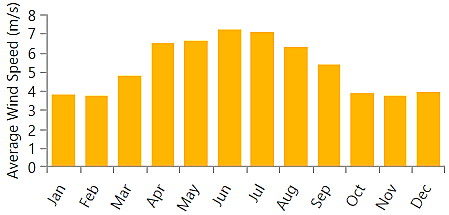
For the proposed problem, an Indian onshore area is considered where the characteristics of month-wise wind power variation are shown in Fig. 5. The data is obtained from NASA, USA worldwide energy resource (power) as mentioned. The selected place for considered wind data is the eastern coastal region in West Bengal state of India with a hub height of 10m. This area is mostly not connected to the grid and also has good wind availability hence the choice.
The IT2FS simulation along with the ANN simulation is done using the MATLAB platform run on an Intel(R) Core (TM) i5-8250U CPU clocked at 1.80 GHz in a personal computer having a RAM capacity of 8GB and an operating system of 64-bit.
From Fig. 3, it is observed that the windiest months are from April to August, and it can be said that most of the power can be generated during these months from the available wind. The prediction of wind is considered from these months when power yield is high from available wind using the proposed technique.
Fig. 6 shows the predicted wind power and the actual wind power availability. Fig. 7 shows the predicted and actual wind power for the higher ranges of power obtained from the output of the wind power forecasting model proposed. From both the above figures, it is observed that the actual and predicted power are quite similar. The plots show the successful predicted power using the proposed technique. Further, some evaluation indices are chosen to determine the feasibility of the proposed technique. These are Mean Absolute Percentage Error (MAPE), Mean Absolute Error (MAE), and Root Mean Square Error (RMSE). They are given as,
| (3) |
| (4) |
| (5) |
where,  is actual power and
  is the predicted power during
  instant.
In the validation study, the proposed scheme is compared with the other two popular prediction schemes of backpropagation and particle swarm optimization (PSO). It is observed from Fig. 8 that for 100 samples predicted, the proposed technique has lower RMSE, MAPE, and MAE values. This validates the proposed technique to be better in small-scale wind prediction.
This paper deals with wind power prediction for a small-scale wind generation system suitable for driving fractional kW loads. The proposed prediction utilizes the randomness of IT2FS and further adjusts the output based on ANN for month-ahead prediction. The study is validated using calculated evaluation error indices. It is observed that the errors are well within the limits and the proposed method is found to be much better than predecessor prediction algorithms. In the future, further multi-objective optimization techniques may be applied similar to energy management problems [30] for better prediction. Further, smart control can be applied to the generator control for cost management [31]. Furthermore, a combination of both physical and statistical methods of prediction can also be applied for prediction of wind power with cost minimization using optimization techniques.
Arunava Chatterjee, Wind Power Forecasting using Type-2 Fuzzy Control and its Optimization based on Artificial Neural Network for Small Scale Wind Power