Journal of Fuzzy Systems and Control, Vol. 3, No 2, 2025 |
ANFIS-Based Fault Detection in Brushed and Brushless DC Motors: A Hybrid Intelligence Approach
Arunava Chatterjee
Department of Electrical Engineering, Raghunathpur Government Polytechnic, Purulia, W.B., India
Email: arunava7.ju@gmail.com
Abstract—Electric motors are a key component in industrial automation and renewable energy systems. Faults like short-circuit and overload conditions may cause performance deterioration, overheating, or even permanent damage. Conventional fault detection techniques depend on threshold-based methods, which are not efficient in handling nonlinear system behavior. The following research introduces an Adaptive Neuro-Fuzzy Inference System (ANFIS) method for fault detection of short-circuit and overload faults in BLDC and DC motors. Through the assessment of input parameters like current, voltage, speed, and temperature, the model efficiently classifies fault conditions with greater accuracy than traditional methods. The outcomes affirm the capability of ANFIS in dealing with nonlinear relationships and enhancing fault detection reliability.
Keywords—Adaptive Neuro Fuzzy Inference System (ANFIS); Brushless DC Motor; Fault Detection; Fuzzy Logic; Motor Faults
DC and BLDC motors are commonly employed in industrial processes because they are controllable and efficient. Use of DC machines is prevalent in traction and automation purposes as they are a better alternative for their purposes due to their characteristics. BLDC, on the other hand, has applications for industries as well as household appliances due to their high torque per weight ratio and easy control. However, nowadays, DC motor usage is much diminished in conventional industries. In industries, mostly industrial machines are used, and conventional fault detection practices are conducted [1]-[4]. DC motors, in contrast, are mostly vulnerable to common faults. They are susceptible to faults such as short circuits and overloads, which can lead to operation failure [5]. Conventional fault detection methods use fixed thresholds, which are not effective in coping with changing motor conditions. To overcome this shortcoming, artificial intelligence (AI)-based methods have been investigated, of which ANFIS is a promising one. BLDC motors, on the other hand, have faults like DC motors as overload and short-circuit faults. Moreover, they also suffer from drive circuit faults and faults of the Hall-effect sensors in the drives. In previous literature, the short-circuit faults [6]-[8] and inverter drivers [9] have been studied extensively. The use of intelligence techniques in fault detection is not properly utilized, as there are computational problems associated with them, often when used in online applications. In BLDC motors, intelligent techniques are, however, often used for minimizing the switching losses and increasing the efficiency of the motors [10] or for motor control [11]. It is, however, shown that the intelligent techniques can often be used for such control or even for effective fault detection for motors [12], [13]. Recently, fuzzy, ANN, or even IoT-based applications are also used for control of such motors and generation control purposes, especially for either loss minimization or better control opportunities [14]-[22]. Even optimization techniques are quite common [23], [24] for optimizing power requirements and reducing losses.
ANFIS is a combination of the learning ability of Artificial Neural Networks (ANNs) and the reasoning power of Fuzzy Logic Systems (FLS) and can be used to process nonlinear and uncertain data. The dynamic adaptability of this hybrid ANFIS to emerging fault conditions makes it the ideal solution for real-time fault detection. Herein, this paper discusses the design and application of an ANFIS-based fault detection system for DC motors in terms of its potential for distinguishing short-circuit and overload faults with high accuracy. This research develops an ANFIS-based fault detection system for DC and BLDC motors, focusing on identifying DC and BLDC motor faults. The system leverages sensor data (current, voltage, speed, and temperature) to classify motor conditions. The study involves data collection, preprocessing, ANFIS model development, training, and evaluation using performance metrics. There are certain advantages of the technique:
The proposed methodology is described in Section III with emphasis on motor faults. Further in Section A, the ANFIS-based fault detection is detailed. Data collection and ANFIS model development are discussed in Section B, Section C, respectively. The simulation and experimental results, and discussions are presented in Section IV. The conclusions and future scope are presented in Section V.
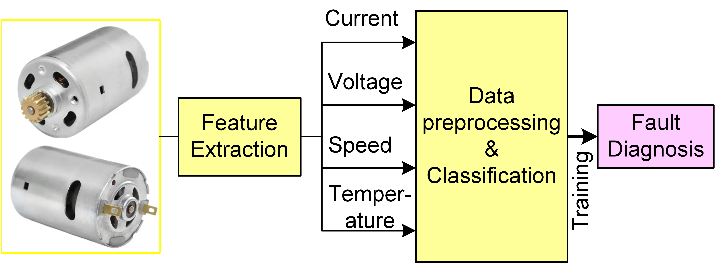
BLDC and DC motor performance and reliability can be significantly impacted by many fault conditions. Insulation breakdown results in short-circuit faults, which will lead to motor burnout, overheating, and abnormal current flow. Overheating, efficiency loss, and low-speed and overload faults can happen in an overloaded motor. BLDC motors can be made to operate randomly due to faults in the Hall sensors, leading to incorrect commutation. The open-circuit fault, where an inefficient phase winding results in efficiency loss and torque loss, is another major fault category in BLDC motors. Nonlinearity of the motor under changing operating conditions complicates the detection of such faults. Classical fault detection methods are threshold-based methods, which may not be dynamic enough to handle changing operating conditions. For simplicity, Hall-sensor faults are not discussed here, and these types of faults can be mitigated using sensible usage and further rectified by replacement of the sensors in the BLDC drives. From Fig. 1, the motor features are extracted via different sensors. The data are then pre-processed using min-max scaling and noise filtering. The data is then sent to ANFIS classifiers, and fuzzy inference is generated using the genfis command in MATLAB. Rules are framed for fault detection. Then the classifier is trained using least squares estimation and backpropagation.
ANFIS is a hybrid intelligent system that combines the data-driven learning property of Artificial Neural Networks (ANNs) and the reasoning and decision-making strength of Fuzzy Logic Systems (FLS). The structure of ANFIS includes five basic layers: the fuzzification layer, which represents numerical inputs with fuzzy values; the rule layer, where the fuzzy IF-THEN rules are processed based on conditions specified; the normalization layer, which scales the strengths of the activation in the rules such that they equal one; the defuzzification layer, where fuzzy outputs are converted to crisp values; and the final output layer, where the system classification output is derived. The main strength of ANFIS lies in its potential to learn from data without trading interpretability, which makes the system an apt one for application in complex nonlinear fault detection schemes.
ANFIS employs adaptive learning techniques to adjust the membership functions and rule base to optimize the accuracy of fault classification. ANFIS is trained using a hybrid learning algorithm with least squares estimation and backpropagation with gradient descent to minimize error. ANFIS can accurately model dynamic motor parameter relationships between current, voltage, speed, and temperature that vary with changing fault conditions. ANFIS flexibility allows it to detect normal operation and fault conditions such as short circuits and overloads in DC and BLDC motors.
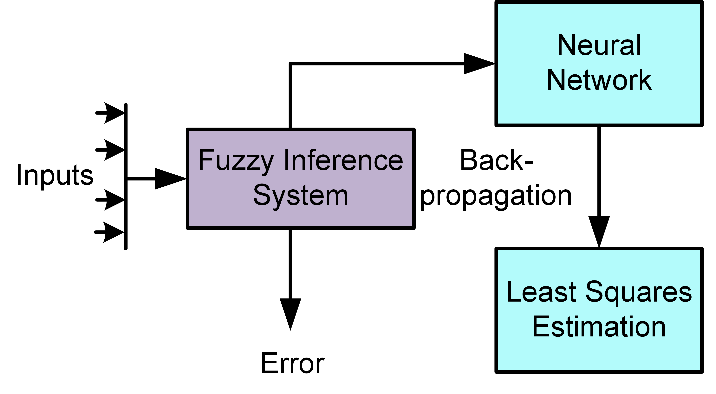
For fault detection, the input parameters are mapped to an initial fuzzy inference system (FIS), which is trained. The number of membership functions for each input is a critical factor in determining model complexity and accuracy. Although increasing the number of membership functions enhances precision, it increases the computational load and memory requirements. Therefore, the trade-off between model complexity and accuracy must be managed with care. One of the primary concerns in the application of ANFIS for motor fault detection is model generalization vs. overfitting. The system can become computationally costly if the rule base becomes too large. Thus, techniques such as feature selection, dimensionality reduction, and rule simplification are used to optimize performance. Training epoch tuning, membership function tuning, and learning rate tuning also optimize fault classification accuracy. The dynamic adaptability of ANFIS to emerging fault conditions makes it the ideal solution for real-time fault detection and predictive maintenance in industrial motor applications. The hybrid ANFIS structure is shown in Fig. 2.
The figure shows a hybrid Adaptive Neuro-Fuzzy Inference System (ANFIS) for detecting faults in DC and BLDC motors. It shows the integration of Artificial Neural Networks (ANNs) and Fuzzy Logic Systems (FLS) for improving fault class accuracy. The system takes input parameters such as current, voltage, speed, and temperature as inputs, which are processed through a fuzzy inference system. Fuzzy IF-THEN logic rules are used in the rule-based engine to determine faulty conditions, and ANFIS adapts these rules based on a hybrid learning algorithm using backpropagation. It is then further refined using least squares estimation. The output of the program indicates motor operating conditions as normal or faulty (short circuit, overload, or open circuit in BLDC motors). The proposed method enhances fault detection by learning nonlinear system dynamics. It is shown to be a reliable method for real-time diagnostics and predictive maintenance of such motors with precision. The system can thus also be embedded in a microcontroller for real-time applications.
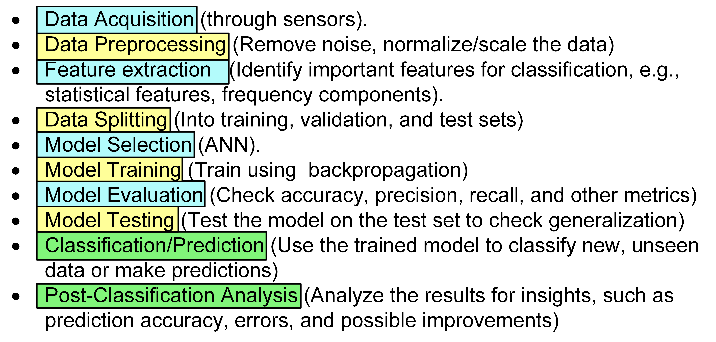
The input data for this study are sensor measurements of DC and BLDC motors, each in healthy and fault conditions. The most critical input parameters are the current, voltage, speed, and temperature data for BLDC motors. These parameters are chosen because they are directly related to motor health. The data are either real-time captured or simulated. For better model performance, the normalization technique min-max scaling is applied to normalize the input features. Feature engineering is also performed to remove redundant parameters and reduce computational burden. Moreover, the data are filtered for the best results. The preprocessed data are split into training and test sets so that the model is validated on unseen samples to prevent overfitting. For ANFIS models in classification tasks, the data samples used for the training set: 60%, the validation set: 20%, testing set: 20%. The workflow diagram summarizing steps from data acquisition to classification is shown in Fig. 3.
In the above workflow diagram, the usage of ANN helps in reinforcement, combining fuzzy logic with neural networks to adaptively tune rules based on error metrics. With new live data input, the same is reinforced using the adaptive feature of the ANN method. This is the advantage of using the ANN method with the hybrid approach as proposed in the work.
The ANFIS model is implemented from a fuzzy inference system (FIS) with membership functions for every input parameter. Membership functions are chosen from the generalized bell function (gbellmf), which yields smooth transitions among fuzzy regions. Model parameters are tuned using the hybrid learning algorithm with least squares estimation and backpropagation.
The training process is carried out over several epochs to fine-tune the rule base and the membership functions. Performance is estimated using metrics such as accuracy, confusion matrix, and root mean square error (RMSE). Fine-tuning involves adjusting the number of membership functions, simplifying the rule base, and increasing training epochs to enhance accuracy without excessive computational complexity. The whole system is tested using MATLAB simulations and experiments performed on a laboratory-scale DC motor prototype.
The training of the ANFIS model is done on real-time obtained experimental data by simulating a fault on the MATLAB system and from the laboratory prototype. Fault conditions, such as short-circuit and overload faults of motors, are simulated physically on a laboratory model with sensors that measure the critical parameters of current, voltage, speed, and temperature. Simultaneously, MATLAB/Simulink is used to simulate the corresponding fault conditions with controlled parameters to generate additional data, such as a wide range of fault conditions. The data so obtained is preprocessed, normalized, and formatted into input-output pairs, sensor values as input, and the nature of the fault as output classification. Such a type of dataset is utilized to train the ANFIS model, which adapts its fuzzy rules and membership functions using a hybrid learning algorithm. The algorithm utilizes least squares estimation and backpropagation. This training process subsequently allows the model to effectively capture the nonlinear characteristics of motor faults and predict real operating conditions.
In this paper, several input parameters are 4 (current, voltage, speed, temperature). The number of membership functions per input is 3. The total fuzzy rules used is 81. Also, the type of membership function used is Generalized bell-shaped (gbellmf).
The model is built using MATLAB programming with inbuilt models in MATLAB Simscape and the power electronics toolboxes. Also, experimental real-time data is collected from a laboratory-scale model. Data logging and collection are done using a microcontroller and voltage, current, and temperature sensors.
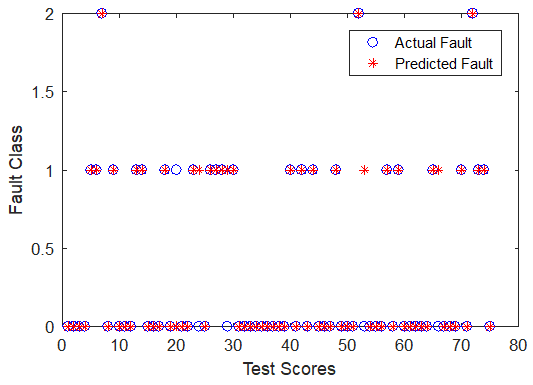
Fig. 4 shows a scatter plot comparing actual fault versus predicted fault classes. The test samples are shown on the x-axis, and the y-axis shows the fault types, where 0 indicates normal operation, 1 indicates a short-circuit fault, and 2 indicates an open-circuit fault condition. Blue circles are actual fault labels from the dataset. Predicted fault labels from the ANFIS model are shown by red stars. A perfect detection is indicated by the alignment of the blue circles and red stars. From the figure, the ANFIS fault detection accuracy is found as 93.33%, which is higher than other available techniques.
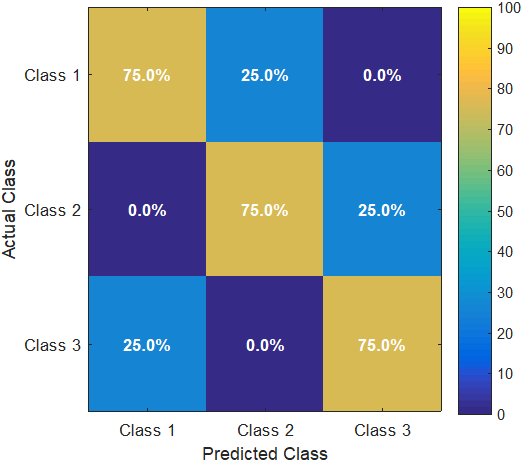
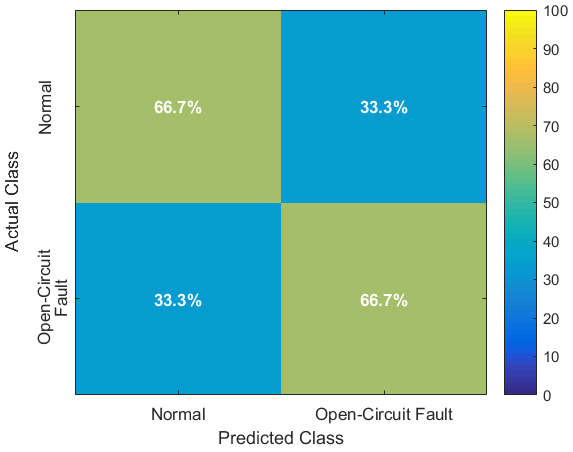
The confusion matrix for the predicted and actual faults is shown in Fig. 5. From Fig. 5 it can be concluded that the predicted fault matches highly with the actual fault class. Classes 1, 2, and 3 in the figure represent the normal operation (healthy motor), short circuit fault, and overload fault, respectively. Fig. 6 shows a similar confusion matrix for BLDC motor open-circuit fault prediction only. The confusion matrices also prove that the predicted faults could be well classified using the proposed ANFIS-based classifier with quite good accuracy.
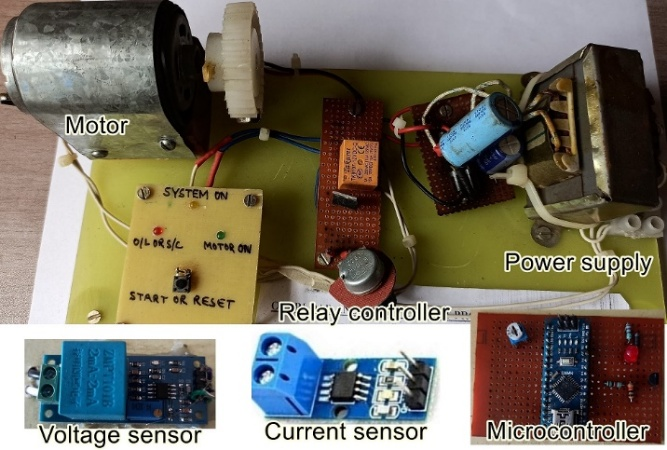
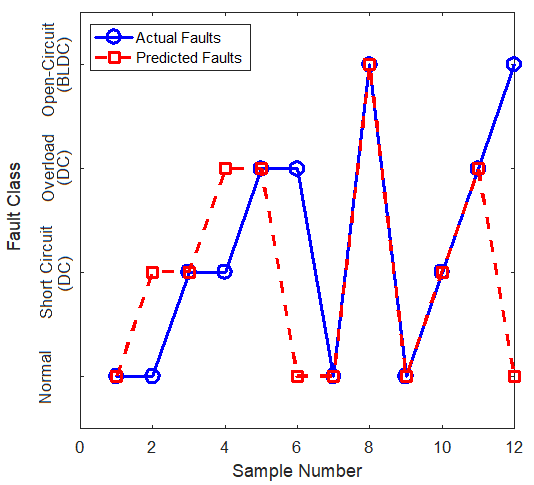
The experimental setup is shown in Fig. 7. The circuit consists of a DC motor of 24V and a relay-based switch operated using a transistor (SC1061) for switch operation during any fault condition. The faults are simulated on the motor, and the sensed data from voltage and current sensors (ZMPT101B and ACS712, respectively) are fed to the Arduino Nano microcontroller for fault classification and necessary motor operation. The LM35 temperature sensor is also used for sensing the temperature, which is not shown in the figure, as it is connected near the motor enclosure. The speed is sensed using an optical digital tachometer. The experimental data obtained sample is shown in Table 1. Fig. 8 shows the actual fault versus the predicted faults using the experimental setup. The faults are detected with ease, barring a few misclassifications due to a lack of better experimental data sampling.
The calculated root mean squared error (RMSE) is found to be 0.6307, which is quite decent for a three-class fault detection problem. Further, a quantitative statistical comparison is done with the available techniques and with the proposed ANFIS-based technique. The other techniques are also implemented using MATLAB programs. The result for the same is tabulated in Table 2.
Current (A) | Voltage (V) | Speed (RPM) | Temp (°C) | Class (Output) |
3.5 | 220 | 1500 | 35 | 1 (Normal) |
3.6 | 221 | 1495 | 34 | 1 |
7.2 | 210 | 1450 | 52 | 2 (Short-Circuit) |
6.8 | 212 | 1400 | 55 | 2 |
5.5 | 215 | 850 | 60 | 3 (Overload) |
5.8 | 218 | 800 | 62 | 3 |
Method | Accuracy (%) | RMSE | Precision | Recall | F1 |
Threshold based | 78 | 1.21 | 0.76 | 0.74 | 0.75 |
ANN | 89.2 | 0.72 | 0.88 | 0.89 | 0.886 |
T1FLC | 90.5 | 0.69 | 0.91 | 0.88 | 0.889 |
Proposed ANFIS | 93.33 | 0.631 | 0.94 | 0.93 | 0.935 |
The statistical comparison reveals that the proposed ANFIS-based fault detection system outperforms conventional methods. It also has the highest accuracy and lowest RMSE. Additionally, the model demonstrates strong robustness, with a precision of 0.94 and a recall of 0.93, resulting in an F1 score of 0.935. In contrast, the threshold-based method significantly lags in performance, highlighting its limitations in handling nonlinear motor behavior.
This research proves the efficacy of ANFIS in DC motor short-circuit, overload, and BLDC motor-related fault detection. The model can classify faults accurately and under nonlinear conditions, as shown by the confusion matrices and RMSE measures. The classification accuracy is much better, 93.33%, than other techniques. Moreover, the RMSE value obtained is 0.6307, which is decent for a three-class fault identification problem. The proposed method is better than conventional threshold-based techniques by applying adaptive learning and fuzzy logic reasoning, as also shown by the statistical comparison. Some limitations may exist, such as computational complexity and overfitting when applying large rule bases, which is common to such techniques. Real-time implementation using embedded hardware and hybrid methods that integrate ANFIS with deep learning methods for predictive maintenance improvement will be addressed in the future. The application of real-time sensor combination methods and the investigation of cloud-based AI diagnostics can further enhance the applicability of ANFIS-based fault detection in industrial applications in the future.
Arunava Chatterjee, ANFIS-Based Fault Detection in Brushed and Brushless DC Motors: A Hybrid Intelligence Approach