Journal of Fuzzy Systems and Control, Vol. 4, No 2, 2026 |
Adaptive Fuzzy Load Prioritization for Energy Management in Hybrid Wind-Solar Microgrids
Arunava Chatterjee 1,*
1 Department of Electrical Engineering, Raghunathpur Government Polytechnic under Department of Technical Education and Training, Government of West Bengal, Purulia, West Bengal, India
Email: 1 arunava7.ju@gmail.com
*Corresponding Author
Abstract—Hybrid renewable microgrids are increasingly becoming popular among renewable energy generation schemes for small-scale power. However, the intermittent nature of both these sources leads to frequent power imbalances between generation and load demand. Conventional control strategies often rely on battery storage for compensation in these cases or employ advanced controls. This paper presents an adaptive Fuzzy logic-based load prioritization strategy for better energy management in such microgrids. The proposed method adjusts the non-critical loads dynamically based on real-time power availability instead of relying on storage only. A fuzzy-based decision technique is used to determine load shedding levels using inputs such as power mismatch, system voltage deviation, and state-of-charge (SOC) of the battery. The proposed control improves system stability and reduces dependency on battery storage. Suitable simulations backed by laboratory-scale experiments demonstrate that the proposed method improves voltage regulation and minimizes load disruption. It significantly reduces voltage deviation by almost 66%, battery current by 43%, and improves power utilization to 97% compared to conventional control systems.
Keywords—Artificial Intelligence; Fuzzy Logic Control; Hybrid Microgrid; Load Prioritization; Renewable Energy; Wind Power
The increasing penetration of renewable sources has greatly transformed the structure of modern power systems. Wind, among all other renewable sources, is popular as a generation source, although its generation is uncertain [1]. This is because wind has a fluctuating nature, and thus a proper complementary source of power with wind is essential [2]. Wind, along with battery [3] is a good choice in these cases, but choosing another renewable source like photovoltaic is better as wind and PV complement each other well [4], [5]. Wind power depends on atmospheric conditions; solar, on the other hand, depends on irradiance throughout the day. Wind power is generally extracted from a wind turbine coupled to generators. Induction generators (IG) are popularly used in most cases [6]-[9]. The wind power generation variability also creates variability in power generation from induction generators. In conventional control strategies for IGs, these variations are controlled using battery storage. This approach increases battery cycling, reduces lifespan, and raises overall system cost.
To address this challenge, demand-side load management has gained popularity as an alternative control strategy [10]. Instead of only controlling supply-side generation, smart control techniques applied for load control can improve system performance. The system can maintain stability by prioritizing critical loads. The non-critical loads can be dynamically adjusted depending on the availability of power. Demand side load management is advantageous as it optimizes energy consumption [11]-[13]. This is done to match the variable nature of wind and changing loads. For this purpose, often load forecasting techniques are adopted [14]. Recently, smart loads are also employed for better load management [15]. All these schemes are generally used for large-scale renewable energy integrations and may not be suitable for microgrids as they are not cost-effective solutions.
Artificial intelligence (AI) techniques can be applied for load control, and it is shown previously that AI-based techniques such as deep learning [16], Fuzzy logic [17], [18], ANN [19], etc., are well-suited for these purposes. This is because they can incorporate heuristic knowledge and provide flexible decision-making without accurate mathematical models. Fuzzy logic is a good choice as it can handle imprecise and fluctuating data associated with wind and solar power. Moreover, it can be used in association with smart control like internet-of-things (IoT) approaches often associated with such control [20]-[23]. All the existing methods either rely heavily on battery storage or employ fixed rule-based load shedding. Also, they do not incorporate multi-variable system conditions, such as battery state-of-charge (SOC) and voltage deviation, simultaneously.
Unlike conventional fuzzy control or load shedding approaches [24], [25], the proposed method incorporates system-level indicators like battery SOC and voltage deviation. The chief contributions of this research are:
Lastly, validation of the proposed strategy is done using simulations and suitable experiments on a laboratory setup.
This paper is structured as follows: Section II discusses the architecture of the proposed system and its modelling. The problem formulation is discussed in Section III. Further, the proposed control strategy is discussed in detail in Section IV. Section V is dedicated to simulation and experimental results. Finally, the conclusion is provided in Section VI along with the scope of future work.
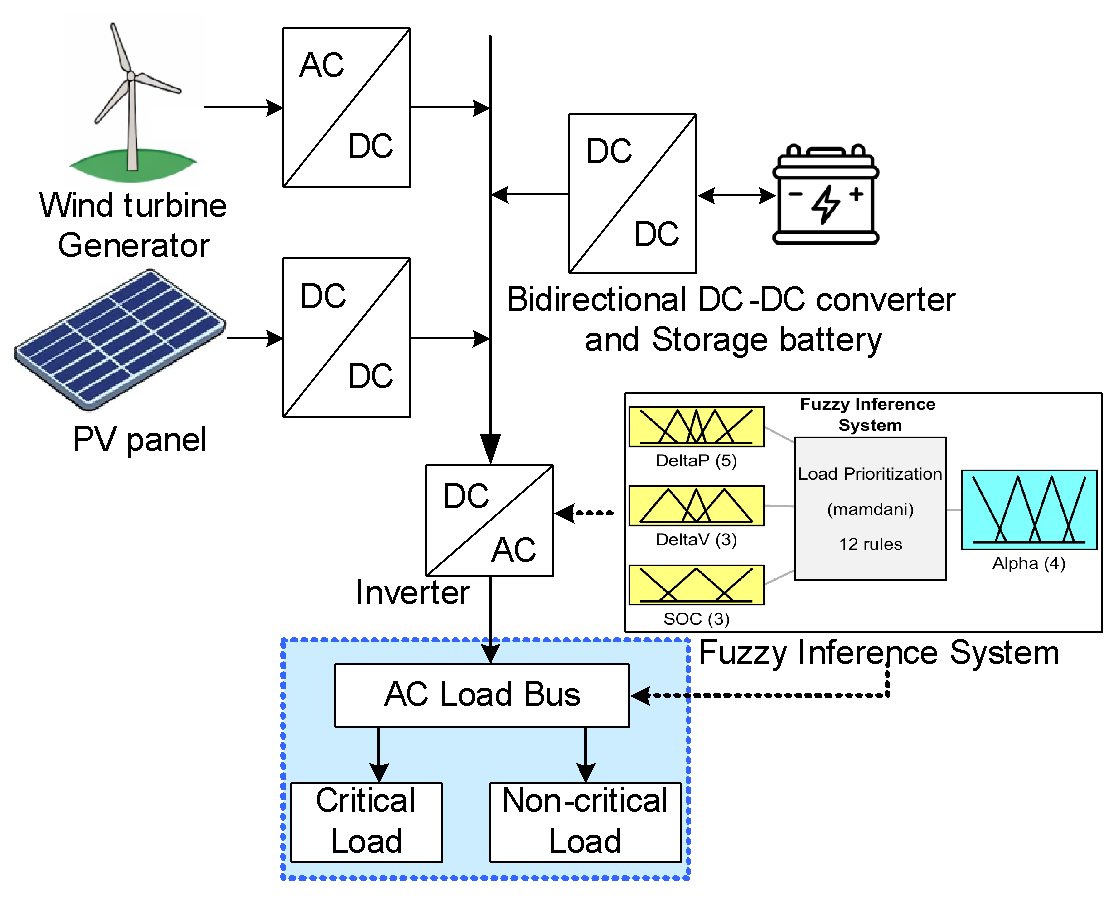
The proposed hybrid microgrid consists of a wind turbine generation, which is a combination of a wind turbine connected to a three-phase induction generator. The generator supplies a combination of critical and non-critical loads. The turbine is a variable wind speed turbine system. The photovoltaic (PV) system is connected via an inverter to the bus, enabling synchronized injection of power into the microgrid. A storage battery is also used as backup during low generation and transients. Fig. 1 shows the proposed system setup.
The system operates with the generation and load dynamic interaction. Due to the fluctuating nature of wind speed and solar irradiance, the generated power continuously varies. This leads to a mismatch between generation and load demand. This mismatch directly affects the bus voltage and the frequency, thus affecting system stability. The instantaneous power balance of the microgrid is expressed as,
| (1) |
where,  and
and  are wind-generated and photovoltaic (PV) generated power,
  is battery power. Load power demand is denoted as
  .
.
The load power is also categorized into two components as,
| (2) |
where,  and
and  are critical and non-critical load components, respectively. Critical loads represent essential loads that must be supplied uninterrupted. Non-critical loads are adjusted based on system conditions.
The power extracted is dependent on the aerodynamic characteristics of the turbine, and it is expressed as,
| (3) |
where,  is air density in kg/m3, turbine sweep area is A,
  is the power coefficient. It is assumed to operate near an optimal value for simplicity. Vω is wind speed through the turbine. The cubic dependence of wind speed shows the high variability of wind power for small changes in speed. The tip speed ratio of the turbine is represented as
  , where
  as rotor speed and R is the radius of the turbine blade. The turbine pitch angle is represented as β.
The power output from a PV panel is governed by the solar irradiance and panel characteristics as,
| (4) |
where,  is the efficiency of the solar panel,
  is the total area of the panel and
  represents the solar irradiance. Solar generation has a smoother daily profile than wind power generation. It is still subject to variations due to cloud cover and other environmental factors.
Although the storage battery acts as a buffer to absorb or supply excess generation, its state-of-charge (SOC) management is a critical component. It is expressed as,
| (5) |
where battery capacity is given as Cbat in Ah. SOC (0) indicates the initial battery SOC at time t = 0. The variable τ is a transitional time variable. This formulation assumes ideal Coulomb counting. The SOC is constrained as,
| (6) |
This is done to prevent battery degradation. The battery is used conservatively in the proposed system. Priority is given to load adjustment.
The voltage is influenced by the instantaneous power balance. Any deviation in balance results in fluctuations in voltage. The approximated relation of voltage balance is given as,
| (7) |
where,  is generated power, and k is a constant of proportionality determined by system impedance and operating conditions. Maintaining power balance is thus essential for voltage regulation.
The primary challenge is to maintain a steady voltage during power fluctuations. The conventional strategies mostly rely on battery storage, as already mentioned. This often leads to increased current stresses and premature ageing of the battery, degrading its performance and reducing its life. In this paper, the formulation of the problem is aimed at a supply-side approach rather than a demand-side one. Here, the net power mismatch is defined as,
| (8) |
A negative value of (8) indicates a deficit of power, whereas a positive value indicates a surplus. A portion of the load is adjusted adaptively for the mismatch. The control objective is thus to minimize voltage deviation and reduce unnecessary load restriction. This is mathematically expressed as,
| (9) |
where,  represents the curtailed non-critical loads. w1 and w2 are weighting factors that determine the balance between voltage regulation and user comfort. A low value of (9) will correspond to improved system performance.
The term ‘adaptive’ in this work refers to real-time adjustment of load shedding decisions based on dynamically varying inputs ( ,
,  , and SOC). This is thus different than fixed-threshold rule-based control. To reduce (9) to an acceptable value, a fuzzy logic controller is designed for load prioritization in real time, thus making it adaptive. The controller operates at the supervisory level and determines the level of load adjustment required based on the conditions. The input variables of the controller are the power mismatch , voltage deviation and battery SOC. The inputs capture the instantaneous state of generation, system stability, and energy storage. The controller output is defined as the load-shedding factor α, which varies as,
| (10) |
The effective load supplied to the system is,
| (11) |
From (11), when α = 0, all loads are supplied, but with changing conditions, a higher value will mean some loads are turned off.
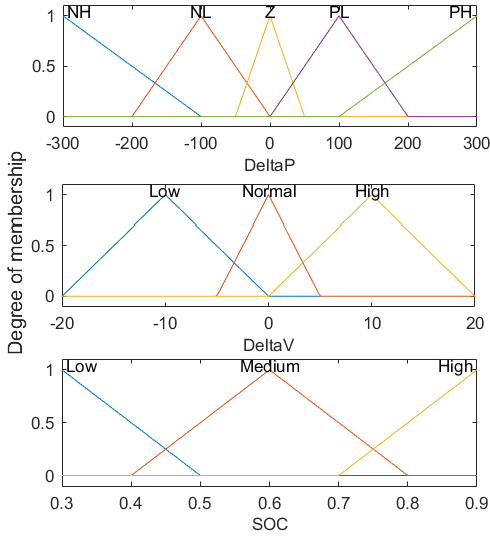
The fuzzy controller uses linguistic variables of Low (L), Medium (M), and High (H) to represent input conditions. Membership functions (MF) are defined over normalized ranges of input variables. A rule base is constructed based on system behavior. The rules are framed as,
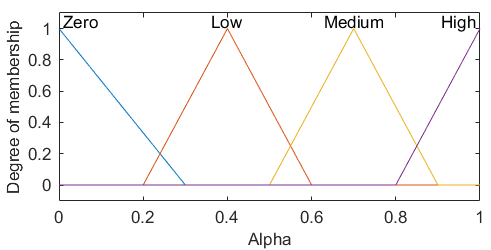
is Negative High and SOC is Low, then α is High. is Low and voltage deviation is Medium, then α is Low. is Positive Low/High, then no load shedding is required, and α is Zero, and so on. The detailed fuzzy rule-base for load shedding is shown in Table 1.Power mismatch has limits [-1,1] p.u., voltage deviation is within [-0.1, 0.1] p.u. and SOC is [0, 100] %. Load shedding factor varies between 0 to 1. Centroid defuzzification is used to obtain the crisp value of α. The rule base is designed heuristically to reduce the objective function (9), where higher load shedding is triggered under conditions of large power deficit, high voltage deviation, and low SOC.
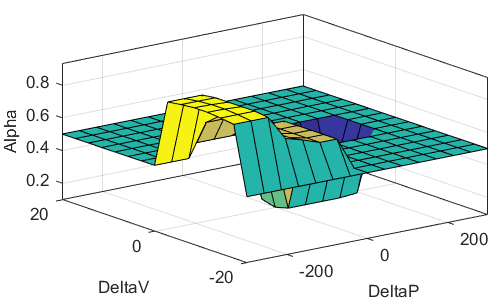
The input membership functions are shown in Fig. 2 with the output membership function shown in Fig. 3. The surface plot of , and load shedding factor is shown in Fig. 4. The plot shows a fuzzy control surface for the variation of the load shedding factor with power mismatch and voltage deviation. This indicates the decision-making of the controller at a constant SOC value. The rising surface indicates the system is in deficit and needs shedding loads, whereas a flat surface or touching zero indicates no shedding is required and there is enough generation.
|
| SOC | Output α |
Positive (Surplus) | Low | High | Zero (Z) |
Positive | Medium | Medium | Zero (Z) |
Positive | High | Low | Low (L) |
Near Zero | Low | High | Zero (Z) |
Near Zero | Medium | Medium | Low (L) |
Near Zero | High | Low | Medium (M) |
Negative (Deficit) | Low | High | Low (L) |
Negative | Medium | Medium | Medium (M) |
Negative | High | Low | High (H) |
High Negative | High | Low | High (H) |
High Negative | Medium | Medium | High (H) |
High Negative | Low | High | Medium (M) |
The fuzzy inputs are defuzzified using the centroid method to obtain a crisp value of α. This value directly controls the switching of non-critical loads. This strategy ensures that load shedding only occurs when it is necessary. The critical loads are unaffected, and the battery storage requirement is also minimized. The voltage deviations are also minimized.
The fuzzy rule base is designed heuristically to minimize the objective function in (9). Higher load shedding is triggered under high voltage deviation and power deficit, thereby reducing the cost function.
The system is simulated using MATLAB and further tested using a laboratory-scale setup. The system consists of a 1 kW, three-phase induction generator, which is coupled to a wind turbine. The wind turbine generator is connected to loads via a bus. The PV system is connected to an inverter on the same bus, enabling synchronized injection of power into the microgrid. The PV panel is rated at 500 W-peak connected to a 1.5 kW, 230 V inverter. A storage battery of 48 V, 20 Ah is also used with the system, with a 30-minute backup time. Harmonics in the inverter output at the load end are reduced using appropriate inverter switching, like selective harmonic elimination [26], [27], and further using filtering. This ensures improved power quality at the load bus. The various parameters are shown, which reflect system performance. Voltage deviation reflects system stability, battery current indicates stress of storage, load shedding represents user comfort, and power utilization shows system efficiency.
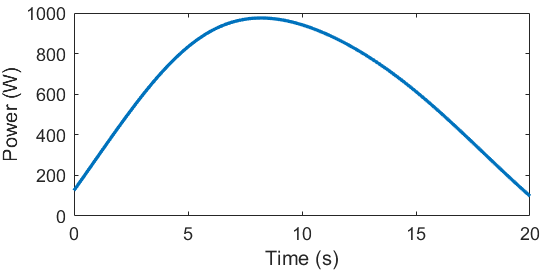
The system is simulated under varying wind speed, solar irradiance, and loads. The hybrid generation power profile is shown in Fig. 5.
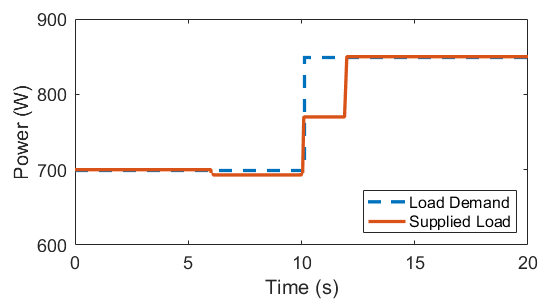
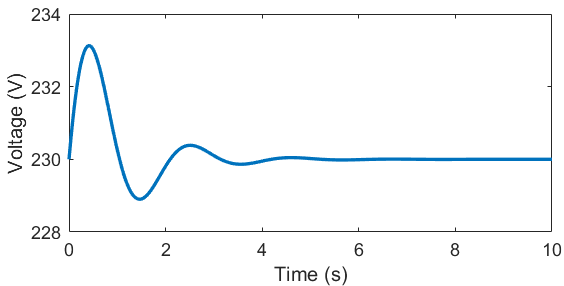
Fig. 6 shows the load demand reference and the supplied load for the proposed control. It is observed that the supplied load closely follows load demand. The supplied load slightly drops during the deficit at around 10s, but increases thereafter. There are no oscillations observed, and an excessive drop is also not observed. The rms AC bus voltage is shown in Fig. 7, and it is observed to be stable throughout at different generations.
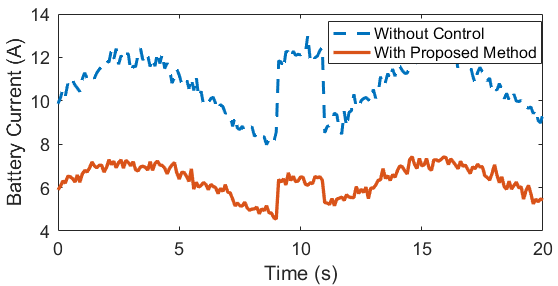
Fig. 8 shows battery current reduction under varying load conditions. The proposed load prioritization strategy reduces the battery current significantly. The transients are also significantly reduced as observed.
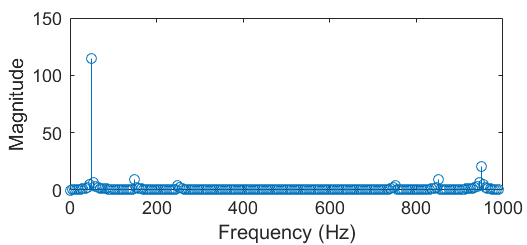
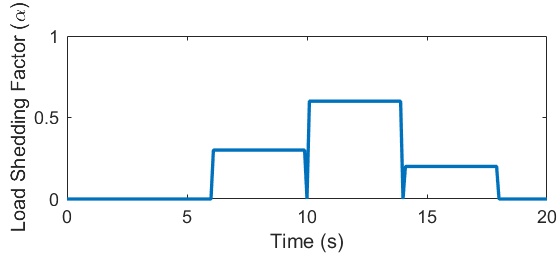
Fig. 9 shows the load voltage harmonic spectrum. It indicates the presence of some mild-level lower-order harmonics. These can be effectively reduced using filtering or using further inverter control. The load shedding factor variation with time is shown in Fig. 10. The factor α represents the fraction of non-critical load shed. It is expressed in per-unit with respect to the total non-critical load. The figure depicts the adaptive nature of the controller. Here, the higher values correspond to increased load shedding during power deficit.
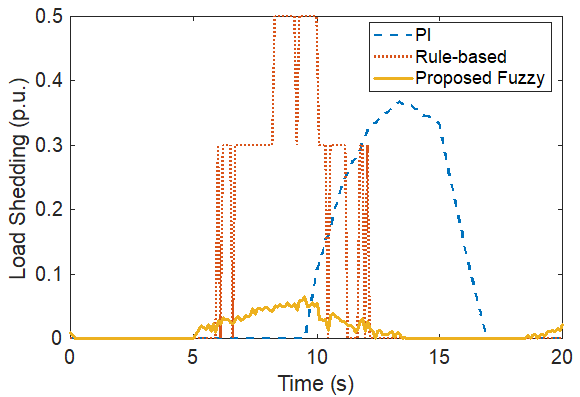
Fig. 11 shows the variation of load shedding behavior under different control strategies. The PI controller exhibits a slower response and a higher magnitude of shedding. The rule-based method shows abrupt changes due to threshold-based operation. The proposed fuzzy controller provides smooth and adaptive load adjustment, thus reducing unnecessary load shedding.
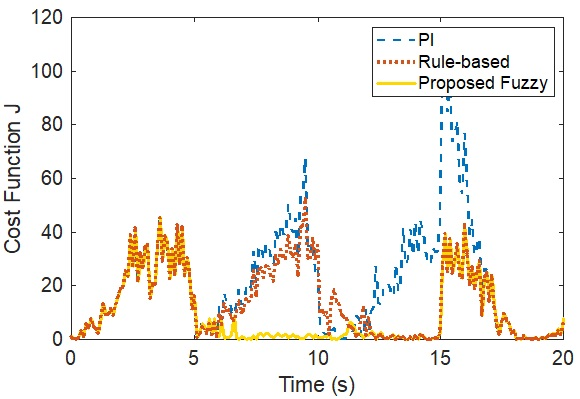
Fig. 12 shows the variation of the objective function of (9). The proposed controller achieves the lowest cost function compared to PI and rule-based methods. This indicates improved voltage regulation with reduced load shedding. This also confirms that the fuzzy rule base is consistent with the objective formulation.
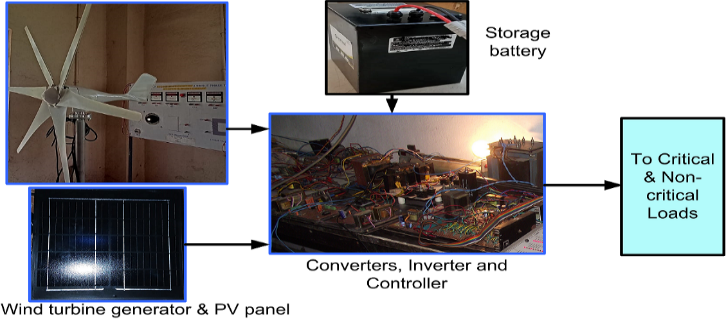
The experimental setup block diagram is shown in
Fig. 13. The experimental results are shown in Table 2. Mainly, performance comparison is done using conventional PI, rule-based load control and proposed control. All controllers are tested under identical wind, solar, and load profiles to ensure fairness. It is observed that the voltage deviation is reduced to below 66%. The battery current is reduced significantly below 43% with minimal load adjustment. This also accounted for lower battery SOC variation. Moreover, the response time and power utilization are also greatly reduced for the proposed control.
Table 3 shows the experimental results for the performance of the proposed system during different operating conditions. It is observed that as available generation increases, the requirement for load shedding and battery support decreases. showing the adaptive system behavior.
Parameters | Conventional PI | Rule-Based Load Control | Proposed Fuzzy-AI control |
Voltage deviation (V) | +12 | +8 | +4 |
Load shedding (%) | 0 | 18 | 11 |
Battery current rms (A) | 11.2 | 8.6 | 6.3 |
SOC variation (%) | 21 | 14 | 8 |
Response time (s) | 3.5 | 2.3 | 1.4 |
Power utilization (%) | 91.5 | 94.2 | 97 |
Condition of Generation | Voltage deviation (V) | Load shedding (%) | Battery current (A) | SOC |
Low wind, | +5.3 | 18 | 7.8 | 11 |
Moderate wind, | +4.1 | 13 | 6.5 | 8 |
High wind, moderate solar | +3.2 | 6 | 5.3 | 5 |
High wind, | +2.5 | 0 | 4.2 | 3 |
This paper presents an AI-assisted load prioritization strategy for hybrid wind-solar AC microgrids. The proposed method adjusts non-critical loads, thus maintaining system balance. Reliance on battery storage is greatly reduced. The fuzzy-based controller effectively manages variable generation and demonstrates improved voltage stability under tested conditions. Simulation results and experimental performance comparisons confirm that the proposed strategy reduces battery stress and improves overall system performance. The proposed control method is simple, practical, and suitable for small-scale microgrids. The adaptive capability is limited to input-driven decision making and is not involved in parameter learning. The future scope of work will focus on real-time applications and the combination with IoT-based monitoring systems for more flexible control.
Arunava Chatterjee, Adaptive Fuzzy Load Prioritization for Energy Management in Hybrid Wind-Solar Microgrids