Journal of Fuzzy Systems and Control, Vol. 4, No 3, 2026 |
Adaptive Fixed-Time Nonlinear Integral Sliding Mode Control for Trajectory Tracking of Unmanned Surface Vehicles under Unknown Disturbances
Hoang Duc Long 1,* , Le Van Tung 2
1, 2 Le Quy Don Technical University, Hanoi, Vietnam
2 Thanh Dong University, Haiphong, Vietnam
Email: 1 longhd@lqdtu.edu.vn, 2 levantungdktd@gmail.com
*Corresponding Author
Abstract—This paper proposes an adaptive fixed-time nonlinear integral sliding mode control scheme for trajectory tracking of unmanned surface vehicles (USVs) subject to nonlinear hydrodynamics and unknown time-varying environmental disturbances. The three-degree-of-freedom USV model is transformed into an inertial-coordinate second-order form, and an integral sliding variable is combined with two power-type reaching terms and a leaky adaptive robust gain that does not require the unknown disturbance bound in the control law. The Lyapunov analysis explicitly distinguishes the ideal and implemented controllers. For the saturation-based implementation, the sliding variable enters an explicitly characterized invariant neighborhood within a fixed time independent of its initial value, and the tracking errors are uniformly ultimately bounded. For the ideal sign-based controller, exact fixed-time sliding and asymptotic tracking are recovered under a separate disturbance-dominance condition. Comparative simulations for circular and straight-line trajectories include computed-torque proportional-derivative and backstepping-proxy benchmarks. For the straight-line trajectory, the proposed method obtains a total tracking-error RMSE of 0.1601, representing reductions of 64.9% and 54.3% relative to the CT-PD and BS-proxy benchmarks, respectively, with a settling time of 0.981 s. The saturation implementation also produces practically smooth control inputs.
Keywords—Adaptive Disturbance Compensation; Fixed-Time Control; Lyapunov Stability; Nonlinear Integral Sliding Mode Control; Trajectory Tracking; Unmanned Surface Vehicle
Recent developments in fuzzy systems and control show that adaptive and robust methods remain effective for uncertain nonlinear systems. Indirect adaptive fuzzy control has been applied to cascade systems affected by bounded disturbances [1], while adaptive fuzzy finite-time observers have improved disturbance estimation in nonlinear tracking systems [2]. These studies emphasize the importance of adaptive and smooth robust-control structures in uncertain environments.
Unmanned surface vehicles (USVs) have attracted increasing attention in ocean observation, hydrographic surveying, environmental monitoring, maritime search and rescue, coastal patrol, and defense-related missions. Recent adaptive fixed-time control for uncertain surface vessels with output constraints has also been reported in [3]. However, accurate USV trajectory tracking remains challenging because of nonlinear coupled dynamics, uncertain hydrodynamics, actuator constraints, network effects, and wind–wave–current disturbances [4], [7], [11]-[13]. Adaptive sliding-mode and disturbance-observer-based designs are reported in [4]-[8], whereas prescribed-time, predictive, and network-aware schemes are presented in [9]-[13].
Sliding mode control (SMC) is widely used for uncertain marine systems because of its robustness against matched disturbances and its direct Lyapunov-based design framework [4], [5], [7], [16], [18]. Nevertheless, conventional SMC usually employs discontinuous switching terms, which may generate chattering, excite unmodeled actuator dynamics, increase energy consumption, and reduce actuator lifetime. To reduce these drawbacks, adaptive SMC, integral SMC, disturbance-observer-based SMC, and saturation-based implementations have been investigated [4], [6], [16], [18], [19]. However, many existing methods still require known disturbance bounds, conservative robust gains, or additional observer dynamics.
Finite-time and fixed-time control have also become important research directions for USV trajectory tracking [6]-[10]. Finite-time control provides faster convergence than asymptotic control, but its settling time usually depends on the initial condition. This dependence is undesirable in USV missions because initial position and heading errors may vary significantly during deployment, path switching, and disturbance recovery. Fixed-time control overcomes this limitation by guaranteeing a convergence-time upper bound independent of initial conditions [7]-[10], [30]. However, several fixed-time controllers still rely on known disturbance bounds or large constant switching gains, which can increase control effort and chattering.
Motivated by these observations, this paper proposes an adaptive fixed-time nonlinear integral sliding mode control (AFxT-NISMC) scheme for trajectory tracking of a disturbed three-degree-of-freedom USV. The design coordinates an integral sliding variable, a nonlinear two-power reaching mechanism, and a leaky adaptive robust gain within the transformed inertial-coordinate model. The adaptive variable adjusts the robust gain online without requiring the unknown disturbance bound in the implemented control law; it is not assumed to estimate that bound exactly. The implemented saturation function reduces switching activity and yields practical fixed-time convergence to a bounded sliding neighborhood. Exact fixed-time sliding is considered separately for the ideal sign-based controller under an additional disturbance-dominance condition.
The main contributions of this paper are summarized as follows. First, a nonlinear integral sliding variable and a two-power reaching mechanism are jointly designed for the transformed inertial-coordinate dynamics of a three-degree-of-freedom USV. Second, a leaky adaptive robust gain is incorporated without using the unknown disturbance bound in the implemented control law, thereby providing online gain adjustment and disturbance attenuation without claiming exact disturbance-bound estimation. Third, a unified Lyapunov analysis establishes practical fixed-time entry into an explicitly characterized invariant sliding neighborhood and uniformly ultimately bounded tracking for the saturation-based controller; conditional exact fixed-time sliding and asymptotic tracking are recovered as an ideal sign-based case. Fourth, the saturation function used in implementation is explicitly included in the analysis instead of being treated as equivalent to the ideal sign function. Finally, the numerical evaluation compares the proposed method with computed-torque proportional-derivative and backstepping-proxy controllers for circular and straight-line trajectories, while Table 1 provides a structured qualitative comparison with recent adaptive and fixed-time surface-vessel methods.
The remainder of this paper is organized as follows. Section II reviews related work on USV trajectory tracking, sliding-mode-based robust control, finite-time and fixed-time control, and adaptive disturbance compensation. Section III presents the three-degree-of-freedom USV model, its inertial-coordinate transformation, and the trajectory-tracking problem. Section IV develops the proposed AFxT-NISMC scheme. Section V establishes practical fixed-time sliding and uniformly ultimately bounded tracking for the saturation-based controller and presents the conditional exact result for the ideal sign-based controller. Section VI reports comparative simulations for circular and straight-line trajectories against the CT-PD and BS-proxy controllers. Finally, Section VII presents the conclusions and future research directions.
Method | Control structure | Disturbance handling | Convergence property | Main limitation |
PD / CT-PD control [24] | Linear or model-based feedback | Limited robustness | Asymptotic | Sensitive to model uncertainty |
Backstepping control [25] | Recursive Lyapunov design | Can handle some uncertainties | Asymptotic or finite-time | Complex design and many parameters |
Conventional SMC [26] | Discontinuous switching control | Robust to matched disturbances | Asymptotic or finite-time | Chattering and conservative gain selection |
Sliding mode with integral error | Improved steady-state accuracy | Usually asymptotic or finite-time | Fixed gains may still be required | |
Nonlinear sliding manifold | Strong robustness | Finite-time | Settling time depends on initial conditions | |
Power-type nonlinear terms | Strong robustness | Fixed-time | Often requires known disturbance bounds | |
Online gain adjustment | Unknown disturbance compensation | Usually asymptotic or finite-time | Fixed-time guarantee may be absent | |
Adaptive fixed-time BLF control [3] | Adaptive fixed-time barrier-Lyapunov design | Unknown disturbances and output constraints | Fixed-time | Requires prescribed output constraints and barrier-function tuning |
Proposed AFxT-NISMC | Adaptive nonlinear integral SMC | Leaky online robust-gain adjustment | Practical fixed-time sliding and UUB tracking; conditional exact convergence in the ideal case | Simulation-based validation and bounded-disturbance assumption |
Trajectory tracking control of unmanned surface vehicles has been extensively investigated because USVs are required to operate accurately under nonlinear hydrodynamics, uncertain parameters, and environmental disturbances caused by wind, waves, and ocean currents. Existing studies related to the present work can be broadly classified into four categories: conventional trajectory tracking control for USVs, sliding mode-based robust control, finite-time and fixed-time control, and adaptive disturbance compensation methods.
Conventional trajectory-tracking controllers for USVs include proportional-derivative (PD) and computed-torque proportional-derivative (CT-PD) control [24], backstepping control [25], and model-predictive or disturbance-observer-based schemes. Adaptive, prescribed-time, and quantization-aware approaches are reported in [4], [5], [11]-[18]. Computed-torque and proportional-derivative-based controllers are attractive because of their simple structure and ease of implementation. However, their performance strongly depends on the accuracy of the nominal model, and tracking errors may increase when unmodeled dynamics or external disturbances are significant. Backstepping control provides a systematic Lyapunov-based design framework for nonlinear marine systems, but the recursive design procedure may lead to complicated control laws and a large number of tuning parameters. Model predictive control can explicitly consider constraints and optimize performance indices, but its real-time computational cost may become high for embedded marine control platforms.
Adaptive and fuzzy-logic controllers have also been developed to improve tracking accuracy under model uncertainty [1], [2], [22], [23]. These methods are useful for approximating unknown nonlinear functions and compensating for uncertain dynamics. Nevertheless, many approximation-based controllers require sufficient excitation, careful parameter tuning, or heavy online computation. Moreover, explicit convergence-time guarantees are not always provided, especially when the vehicle is affected by time-varying environmental disturbances.
Sliding Mode Control has been widely applied to USVs and other marine vehicles because of its strong robustness against matched uncertainties and external disturbances [4], [5], [7], [8], [19]. By forcing the system trajectory onto a prescribed sliding manifold, SMC can reduce the influence of disturbances and parameter variations. However, conventional first-order SMC usually employs discontinuous switching terms, which may generate chattering in the control input. In practical marine systems, chattering can excite unmodeled dynamics, increase actuator wear, and reduce control smoothness.
To overcome this limitation, integral and terminal sliding-mode designs have been investigated for marine-vehicle tracking [27]-[29], while adaptive and fixed-time SMC schemes for USVs are reported in [4], [5], [7], [19]. Integral sliding mode control is particularly useful for trajectory tracking because the integral term helps reduce steady-state errors caused by persistent disturbances. Higher-order sliding mode techniques can reduce chattering while preserving robustness. However, many existing sliding mode controllers still rely on fixed switching gains or require prior knowledge of disturbance bounds. If the gains are selected too small, robustness cannot be guaranteed; if they are selected too large, excessive control effort and residual chattering may occur.
Finite-time control has attracted considerable attention because it guarantees convergence of the tracking error within a finite settling time [20], [21], [28], [29]. Compared with asymptotic control, finite-time control provides faster transient response and stronger disturbance rejection. Terminal sliding mode control and nonsingular terminal sliding mode control are typical finite-time approaches used in nonlinear control systems. However, the convergence time of finite-time controllers usually depends on the initial condition. This dependence is undesirable in USV missions because the initial position and heading errors may vary significantly during deployment, path switching, or disturbance recovery.
Fixed-time control addresses this issue by ensuring that the convergence time is uniformly bounded and independent of initial conditions [30]. This property is highly attractive for autonomous marine vehicles because it provides a predictable upper bound for transient performance. Recent fixed-time and prescribed-time surface-vessel designs include adaptive barrier-Lyapunov, disturbance-observer, sliding-mode, and prescribed-performance approaches [3], [6]-[9]. Existing fixed-time controllers often employ two nonlinear terms with different powers: one term with a power less than one to accelerate convergence near the equilibrium point, and another term with a power greater than one to dominate large initial errors. Nevertheless, several fixed-time sliding mode controllers still assume that the upper bound of the disturbance is known. In marine environments, this assumption is restrictive because wind, waves, and currents are time-varying and difficult to measure accurately.
Adaptive robust-gain and disturbance-compensation methods have been introduced to reduce conservative fixed-gain selection [4], [5], [15], [20], [21]. In adaptive SMC, the switching or robust gain is adjusted online according to the sliding variable or tracking error. When the error is large, the gain can increase to improve robustness, whereas a leakage term allows it to decrease as the error becomes small, thereby limiting excessive control effort. Disturbance-observer-based controllers estimate lumped disturbances and compensate for them in the control law [6], [8], [12], [14], [16].
Although adaptive disturbance compensation improves robustness, several limitations remain. Many adaptive laws provide only asymptotic or finite-time results, whereas exact fixed-time convergence may require an additional disturbance-dominance condition. Leaky adaptation prevents unlimited gain growth but does not by itself guarantee that the adaptive gain exceeds the unknown disturbance bound. Moreover, replacing the ideal sign function with a saturation function generally yields convergence to a bounded neighborhood rather than exact sliding. These issues motivate a coordinated design and analysis that distinguishes the implemented saturation controller from the conditional ideal sign-based case.
The present study does not claim that integral SMC, dual-power fixed-time feedback, or adaptive disturbance compensation is individually new. Its contribution lies in their coordinated integration for the transformed inertial-coordinate dynamics of a three-degree-of-freedom USV. Compared with closely related adaptive and fixed-time surface-vessel controllers [3], [6]-[9], the proposed design combines an integral sliding variable, two power-type reaching terms, and a leaky adaptive robust gain, while explicitly accounting for the saturation function used in implementation. The resulting analysis establishes practical fixed-time entry into an invariant sliding neighborhood and uniformly ultimately bounded tracking for the implemented controller. Conditional exact fixed-time sliding and asymptotic tracking are recovered only for the ideal sign-based controller under an additional disturbance-dominance condition.
The main research gaps addressed in this paper are summarized as follows:
To further clarify the relationship between the proposed approach and existing methods, a comparative summary is given in Table 1.
This section presents the mathematical model of a three-degree-of-freedom unmanned surface vehicle (USV), the transformation from the body-fixed coordinate frame to the inertial coordinate frame, and the trajectory tracking problem considered in this paper. Throughout this paper,  denotes time and an overdot denotes differentiation with respect to time. The symbols
  ,
,  , and
, and  denote the vector 1-norm, Euclidean norm, and maximum-component norm, respectively. For a symmetric matrix
  ,
,  denotes its minimum eigenvalue. The notation
  denotes the
  identity matrix, and
  denotes a diagonal matrix formed from its arguments. Consider the planar motion of an unmanned surface vehicle moving in surge, sway, and yaw as in Fig. 1.
In Fig. 1,  denotes the inertial reference frame,
  and
and  are the planar position coordinates,
  í the yaw angle, and
  ,
,  , and
, and  denote the surge velocity, sway velocity, and yaw rate in the body-fixed frame, respectively.
Let,
| (1) |
be the position-heading vector in the inertial frame, where  and
and  denote the planar position coordinates and
  denotes the yaw angle. Let,
| (2) |
be the velocity vector in the body-fixed frame, where  ,
,  , and
, and  denote the surge velocity, sway velocity, and yaw rate, respectively.
The standard three-degree-of-freedom kinematic and dynamic model of the USV is given by
| (3) |
where  is the inertia matrix including added mass,
  is the Coriolis and centripetal matrix,
  is the hydrodynamic damping matrix,
  is the generalized control input in the body-fixed frame, and
  represents the lumped environmental disturbance caused by wind, waves, and ocean currents.
The transformation matrix from the body-fixed frame to the inertial frame is
| (4) |
Since  is an orthogonal rotation matrix, its inverse satisfies
| (5) |
From the kinematic equation in (3), the body-fixed velocity can be expressed as
| (6) |
Differentiating (6) with respect to time gives
| (7) |
Substituting (6) and (7) into the dynamic equation in (3) yields
| (8) |
Premultiplying both sides of (8) by  , the USV dynamics can be rewritten in the inertial coordinate frame as
| (9) |
where,
| (10) |
| (11) |
| (12) |
| (13) |
In (9),  is the transformed inertia matrix,
  is the transformed Coriolis and centripetal matrix,
  is the transformed hydrodynamic damping matrix,
  is the control input in the inertial coordinate frame with
  ,
,  , and
, and  are the generalized control-force/moment components associated with the
  ,
,  , and yaw channels, respectively,
  is the transformed environmental disturbance.
Remark 1. The disturbance  is considered as an additive generalized disturbance in the body-fixed dynamics. Therefore, after coordinate transformation, the disturbance appears as an additive term in the inertial-coordinate model (9). This sign convention is used consistently throughout the controller design and stability analysis.
Under Assumption 1 and the coordinate transformation (10), the transformed inertia matrix is uniformly symmetric positive definite. Moreover, under Assumption 4, its time derivative is bounded. Therefore, there exist positive constants  ,
,  and
and  such that
| (14) |
Let  be the desired reference trajectory, where
  ,
,  , and
, and  are the desired position and yaw angle of the USV.
The tracking error is defined as
| (15) |
and its derivative is
| (16) |
The second derivative of the tracking error is therefore
| (17) |
From (9), the acceleration of the USV in the inertial frame can be written as
| (18) |
Substituting (18) into (17) gives
| (19) |
The following assumptions are introduced for controller design and stability analysis.
Assumption 1. The inertia matrix  is symmetric positive definite. Since
  is nonsingular, for all the transformed inertia matrix is also symmetric positive definite. Therefore, there exist positive constants and such that,
| (20) |
Assumption 2. The reference trajectory  is twice continuously differentiable, and its first two derivatives are bounded. Thus, there exist positive constants
  , and
, and  such that,
| (21) |
Assumption 3. The transformed environmental disturbance is componentwise bounded, but its upper bound is unknown. Thus, there exists an unknown positive constant  such that,
| (22) |
where denotes the maximum-component norm.
Assumption 4. For all yaw angles and bounded USV velocities  , equivalently bounded
  , the transformed model matrices and the time derivative of the transformed inertia matrix are bounded. Thus, there exist positive constants
  ,
,  ,
,  , and such that,
| (23) |
Remark 2. Assumption 1 is standard in marine-vehicle dynamics because the inertia matrix, including added mass, is positive definite. Assumption 2 permits both bounded reference paths and unbounded position references, such as straight-line trajectories, provided that their velocity and acceleration are bounded. Assumption 3 reflects the practical condition that wind, wave, and current disturbances are bounded component-wise, although their exact upper bound is unavailable to the controller. Assumption 4 provides the matrix and inertia-derivative bounds required in the Lyapunov analysis; it does not require the absolute USV position to remain bounded.
The objective of this paper is to design a control input  for the inertial-coordinate USV model (9) such that the actual trajectory
  tracks the desired trajectory under unknown time-varying environmental disturbances.
More specifically, the saturation-based controller implemented in this paper should guarantee the following properties:
 and its derivative
  remain bounded for all
  . and its derivative are uniformly ultimately bounded. For the ideal sign-based controller, under a separate disturbance-dominance condition, exact fixed-time sliding is recovered and
| (24) |
is not required to be bounded when the reference position is unbounded..To achieve these objectives, the next section constructs an adaptive fixed-time nonlinear integral sliding mode control scheme based on the inertial-coordinate model (9), the tracking error definitions (15) and (16), and the bounded disturbance condition (22).
This section develops the proposed adaptive fixed-time nonlinear integral sliding mode control scheme for the USV model (9). The design combines an integral sliding variable, a nonlinear two-power reaching mechanism, and a leaky adaptive robust gain to provide trajectory tracking under unknown time-varying environmental disturbances. The saturation function used in the implemented controller is retained explicitly so that its practical fixed-time behavior can be distinguished from the conditional exact result associated with the ideal sign-based controller.
From Section III, the USV dynamics in the inertial coordinate frame are given by (9), while the tracking error and its derivative are defined by (15) and (16), respectively. To improve steady-state tracking accuracy under persistent environmental disturbances, an integral error state is introduced as
| (25) |
where  denotes the prescribed initial value of the integral-error state.
The nonlinear integral sliding variable is defined as,
| (26) |
where,
| (27) |
and
| (28) |
Here,  and
and  ,
,  , are design parameters. The term
  improves the transient response of the tracking error, while the integral term
  helps reduce the steady-state tracking error caused by persistent disturbances.
Differentiating (26) with respect to time gives
| (29) |
Substituting (17) into (29) gives
| (30) |
Multiplying both sides of (30) by , we obtain
| (31) |
From the USV model (9),
| (32) |
Substituting (32) into (31) yields,
| (33) |
For compactness, define the combined transformed Coriolis–damping matrix as,
| (34) |
Then (33) can be written as
| (35) |
From the definition of the sliding variable (26), we have
| (36) |
Using (16), the velocity can be expressed as,
| (37) |
Substituting (36) into (37) gives
| (38) |
Substituting (38) into (35), one obtains
| (39) |
where the known nominal compensation term  is defined by,
| (40) |
The term contains the nominal model information, the reference trajectory, and the tracking-error variables. It will be used to compensate for the known part of the USV dynamics.
The control input is selected in the following form:
| (41) |
where  is a robust nonlinear term to be designed.
Substituting (41) into (39) gives,
| (42) |
Equation (42) shows that the tracking-control problem is transformed into the robust stabilization problem of the sliding variable  under the unknown disturbance .
To construct the two-power reaching dynamics, two nonlinear terms with exponents on opposite sides of unity are introduced. For any vector  and any positive scalar
  , define,
| (43) |
In (43), the scalar convention  is used; therefore,
  is continuous for every .
For the conditional ideal controller, define the set-valued sign mapping componentwise as,
| (44) |
The implemented controller uses the following continuous boundary-layer approximation:
| (45) |
with the small constant  .
.
The robust nonlinear auxiliary control term is proposed as
| (46) |
where  ,
,  ,
,  ,
,  ,
,  .
.
Substituting (46) into (42), the closed-loop sliding dynamics are obtained as
| (47) |
The adaptive law is chosen as
| (48) |
where  is the adaptation gain,
  is the leakage gain, and
  is a leaky adaptive robust-gain variable. It adjusts the robust control magnitude online but is not assumed to estimate, converge to, or remain greater than the unknown disturbance bound .
Substituting the robust term (46) into the control structure (41), the final adaptive fixed-time nonlinear integral sliding mode controller is obtained as
| (49) |
Here, is defined by (40), is defined by (26), and the adaptive robust-gain variable is updated by (48). Equation (49) is the saturation-based controller implemented in the simulations, for which practical fixed-time sliding and uniformly ultimately bounded tracking are established in Section V. The ideal sign-based controller is obtained by replacing the saturation term with an ideal set-valued sign term and imposing a separate disturbance-dominance condition; it is considered only in the conditional ideal-case result in Theorem 3.
This section presents the Lyapunov-based stability analysis of the closed-loop system consisting of the USV dynamics (9), the integral sliding variable (26), the adaptive law (48), and the saturation-based controller (49). The principal result establishes practical fixed-time entry of the sliding variable into an explicitly characterized invariant neighborhood without assuming that the adaptive robust gain dominates the unknown disturbance. The corresponding tracking-error dynamics are shown to be uniformly ultimately bounded. Conditional exact fixed-time sliding and asymptotic tracking are recovered separately for an ideal sign-based controller under an independently imposed disturbance-dominance condition.
Lemma 1. Consider a positive definite scalar function  . If there exist positive constants
  , and real constants
  satisfying
  such that
| (50) |
then converges to zero within a fixed time. Moreover, the settling time (T) satisfies
| (51) |
The upper bound in (51) is independent of the initial value  .
.
This standard fixed-time stability result follows from the comparison principle reported in [30].
Lemma 2. Consider the adaptive law (48). If is bounded, then the adaptive robust-gain variable remains positive and bounded for all .
Proof. The solution of (48) can be written as
| (52) |
Because  and
and  , it follows that
| (53) |
If is bounded, then there exists a positive constant  such that
| (54) |
Using the bound (54) in the solution (52), one obtains
| (55) |
Since
| (56) |
it follows that
| (57) |
Therefore,
| (58) |
Thus, remains positive and bounded whenever is bounded. However, Lemma 2 does not imply that  .
.
The following theorem establishes practical fixed-time convergence for the implemented saturation-based controller without requiring the unsupported condition .
Theorem 1. Consider the USV dynamics (9), the integral sliding variable (26), the adaptive law (48), and the saturation-based controller (49). Suppose Assumptions 1-4 hold. Define the adaptive-gain deficiency by
| (59) |
where  . Furthermore, suppose that
| (60) |
Then, for every  , the sliding variable enters an explicitly characterized invariant neighborhood of the origin within a fixed time independent of its initial value. Moreover, is uniformly ultimately bounded.
Proof. Choose the Lyapunov function
| (61) |
From Assumption 1,
| (62) |
Define
| (63) |
Using the saturation-based closed-loop dynamics (47), the derivative of  is
is
| (64) |
Let  and
and  .
.
Because 
| (65) |
Because
| (66) |
Using Assumption 4 and the definition of  in (60)
| (67) |
For each component, the saturation residual is zero when  , whereas for
  ,
,  .
.
Consequently,
| (68) |
From Assumption 3,  . Therefore,
| (69) |
Young’s inequality gives
| (70) |
| (71) |
where  .
.
Using the upper bound in (62) and omitting the additional negative quadratic term gives
| (72) |
where  ,
,  ,
,  ,
,  .
.
For an arbitrary , let  be the unique solution of,
| (73) |
Whenever  , (73) implies
| (74) |
Therefore, the set  is positively invariant and is reached within a time satisfying
| (75) |
The bound  is independent of
  . Finally, from the lower bound in (62),
| (76) |
Thus, the implemented controller guarantees practical fixed-time convergence of to an invariant neighborhood. For an initial-condition-independent conservative neighborhood, one may use  in the definition of
  .
.
The following result establishes boundedness of the main closed-loop signals.
Theorem 2. Under the conditions of Theorem 1, the augmented tracking-error state  and the derivative are uniformly ultimately bounded. Moreover, , , ,
  , , and remain bounded for all .
Proof. Define
| (77) |
Define  ,
,  ,
,  ,
,  . Then (77) becomes
| (78) |
Because  and
and  are diagonal positive-definite matrices, each channel has the characteristic polynomial.
| (79) |
whose roots have negative real parts. Hence,  is Hurwitz.
Therefore, there exist constants  and
and  such that.
| (80) |
After the fixed entry time , Theorem 1 gives  . The variation-of-constants formula consequently yields, for all
  ,
,
| (81) |
Therefore,
| (82) |
Because and are components of  , they have the same ultimate-bound characterization. Moreover, from the second equation in (78).
| (83) |
Theorem 1 establishes the boundedness of , and Lemma 2 then establishes the boundedness of . Equations (77)-(83) establish the boundedness of , , and . Finally, Assumptions 2 and 4 and the controller expression (49) imply that ,  , the nonlinear power terms, and the saturation term remain bounded. Hence, is bounded. Notice that the absolute position is not claimed to be bounded when tracking an unbounded straight-line reference.
For the ideal sign-based controller, once the sliding variable reaches the origin, the error dynamics reduce to an exponentially stable linear system. This is stated in the following theorem.
Theorem 3. Consider the ideal discontinuous controller obtained by replacing the saturation term in (46) and (49) with  , where the robust gain independently satisfies,
| (84) |
Under Assumptions 1–4 and condition (60), the sliding variable reaches the origin within a fixed time, and the tracking-error states converge asymptotically to zero.
Proof. For the ideal set-valued sign function,
| (85) |
Moreover, because  the corresponding Filippov inclusion contains
  at
at  . Therefore, the sliding manifold is invariant in the Filippov sense. Thus, the residual constant in (72) becomes , and Lemma 1 gives,
| (86) |
where  .
.
Once  , (78) reduces to
  . Since is Hurwitz,
  , which proves the stated asymptotic tracking result.
Therefore, the implemented saturation-based controller guarantees practical fixed-time sliding convergence and uniformly ultimately bounded trajectory tracking. Exact fixed-time sliding and asymptotic tracking are obtained only for the conditional ideal sign-based controller described in Theorem 3.
This section presents numerical simulations to verify the effectiveness of the proposed adaptive fixed-time nonlinear integral sliding mode controller for trajectory tracking of unmanned surface vehicles under unknown environmental disturbances. The proposed controller is compared with two benchmark controllers: a computed-torque proportional-derivative controller, denoted as CT-PD, and a backstepping-proxy controller, denoted as BS-proxy. The simulations are conducted for two representative reference trajectories: a circular trajectory and a straight-line trajectory. These two scenarios are selected to evaluate both curved-path tracking and translational path-following performance. For practical numerical implementation and chattering reduction, the discontinuous sign function in the robust term is approximated by the saturation function.
The simulated plant is the three-degree-of-freedom USV model in the inertial-coordinate form (9). The inertia matrix in the body-fixed frame is selected as in [24]. The environmental disturbance is chosen to represent a bounded wind-wave-current-type generalized force and moment in the body-fixed frame:
| (87) |
where  for the circular trajectory and
  for the straight-line trajectory.
The controller gains are selected as  and
and  . The fixed-time power exponents are
  ,
,  . The diagonal gain matrices are
  ,
,  ,
,  . The leaky adaptive robust-gain variable is implemented as (48) with
  ,
,  ,
,  . To reduce chattering, the discontinuous sign function in the robust term is replaced by the saturation function (45) with
  .
.
To quantitatively compare the controllers, the following indices are used. The root-mean-square tracking errors are
| (88) |
The total tracking-error RMSE is
| (89) |
The integral absolute error is
| (90) |
The first scenario is a circular trajectory defined by
| (91) |
where  ,
,  .
.
The initial condition is  ,
,  .
.
Fig. 2 to Fig. 6 show the comparative tracking performance for the circular trajectory. As observed from the  trajectory and the position-heading responses, the proposed AFxT-NISMC controller enables the USV to follow the desired circular path with faster transient convergence and smaller deviation than CT-PD and BS-proxy. The tracking-error curves further confirm that the proposed method suppresses
  ,
,  , and
, and  more rapidly, while maintaining small steady-state errors under the wind–wave–current-type disturbance. In addition, the norm plots indicate that both the tracking error and the sliding variable decrease effectively, consistent with the practical fixed-time entry result of Theorem 1 of the proposed design. The control inputs remain bounded, and the saturation-based implementation of the robust term reduces excessive switching while preserving strong disturbance rejection. These results are consistent with the quantitative comparison in Table 2, where the proposed controller gives the smallest total RMSE and IAE for Case 1.
Controller |
|
|
|
| IAE | Settling time [s] |
Proposed AFxT-NISMC | 0.19124 | 0.35692 | 0.10779 | 0.41902 | 4.7675 | 1.613 |
CT-PD | 0.51549 | 0.86748 | 0.38276 | 1.0792 | 21.5333 | 16.154 |
BS-proxy | 0.42402 | 0.65552 | 0.29178 | 0.83345 | 11.3185 | 7.278 |
The second scenario is a straight-line trajectory given by
| (92) |
with  ,
,  .
.
The initial condition is  , .
, .
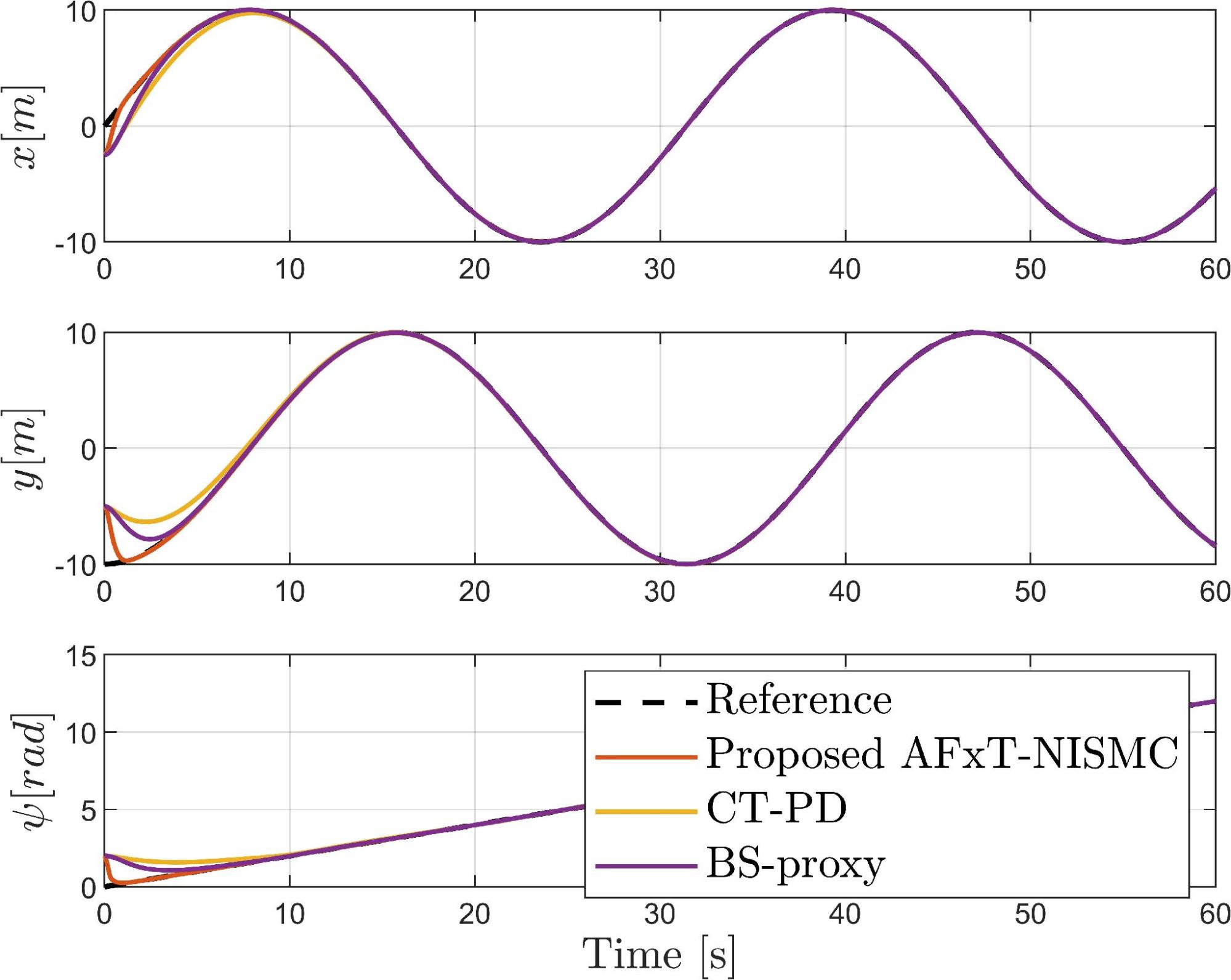
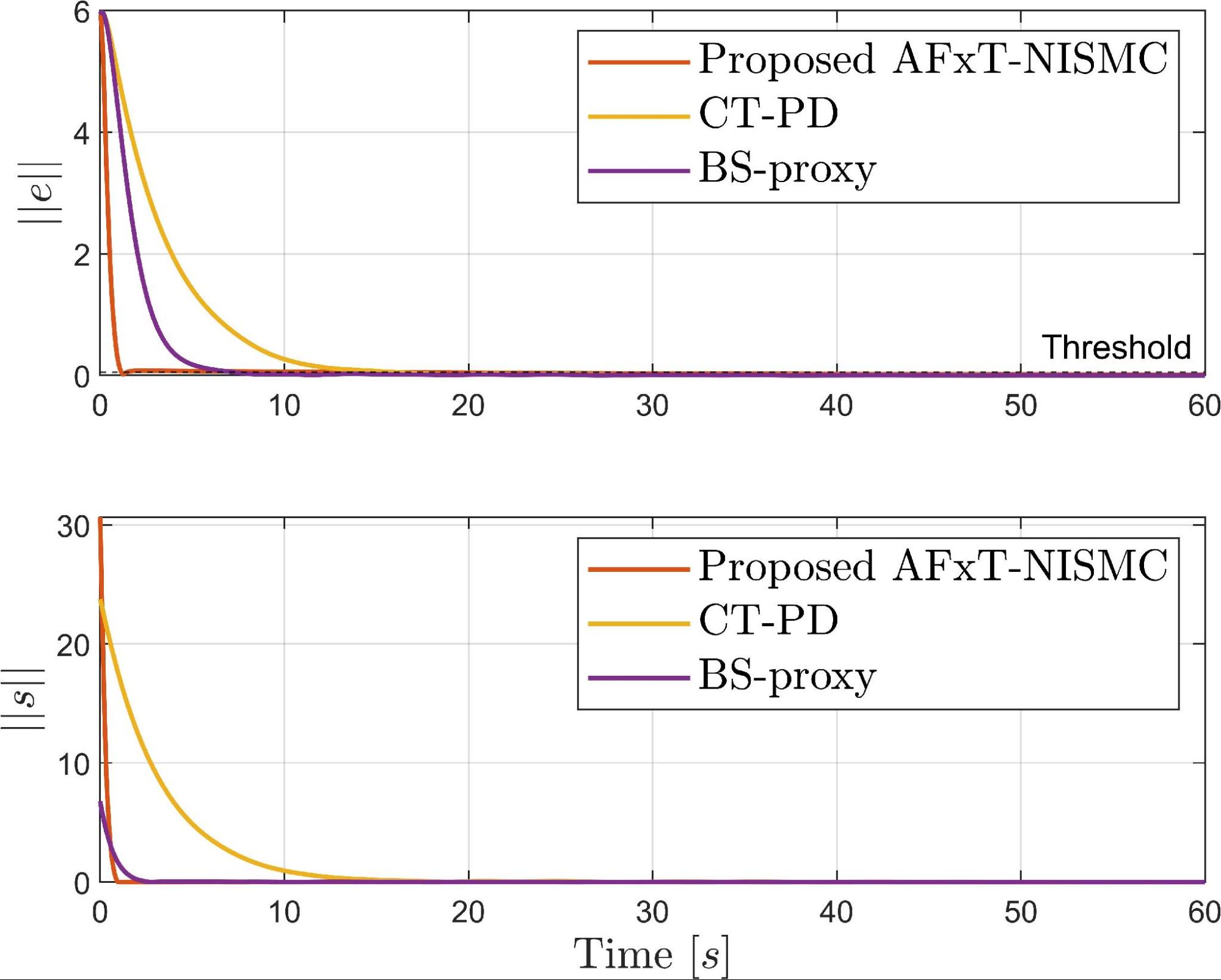
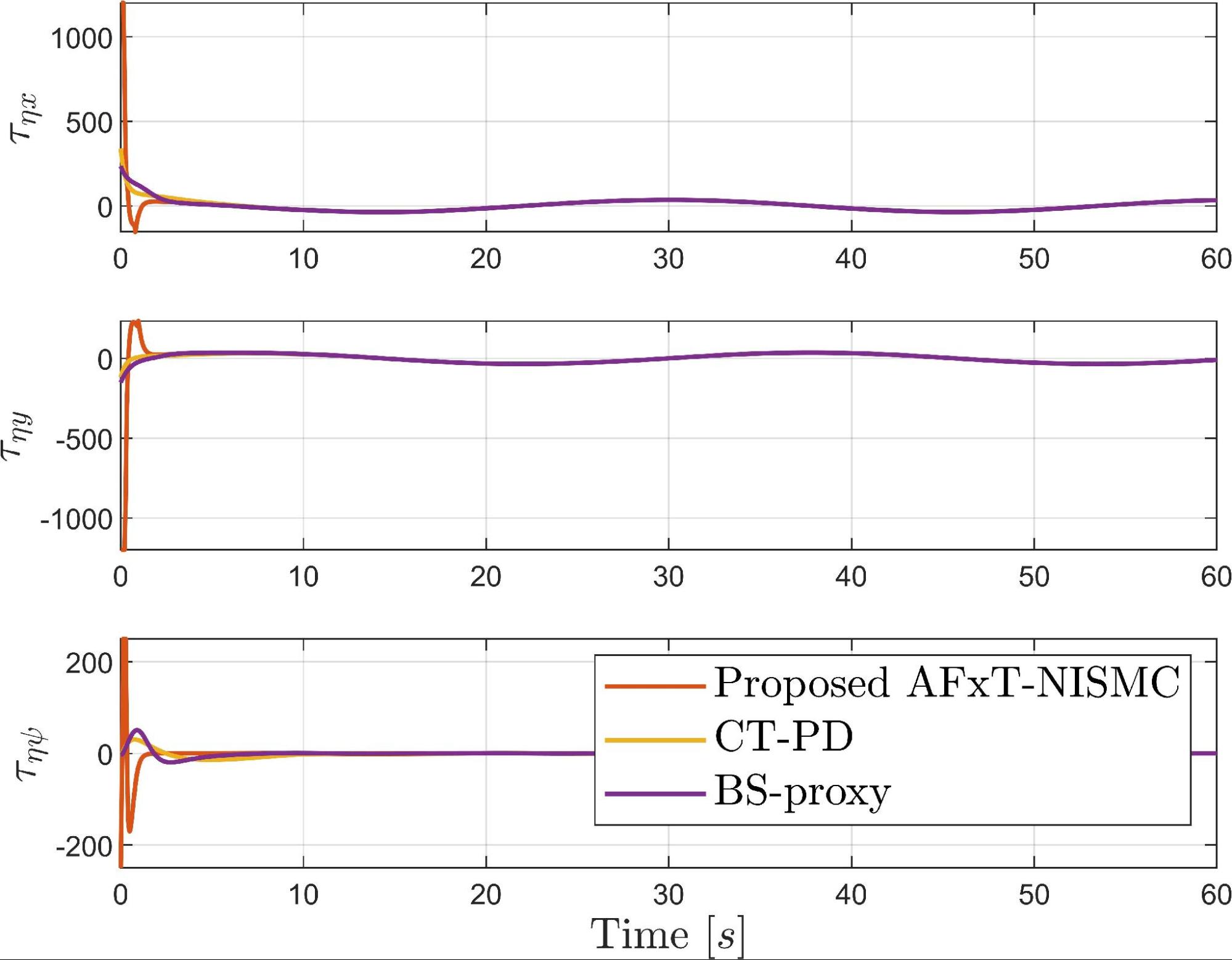
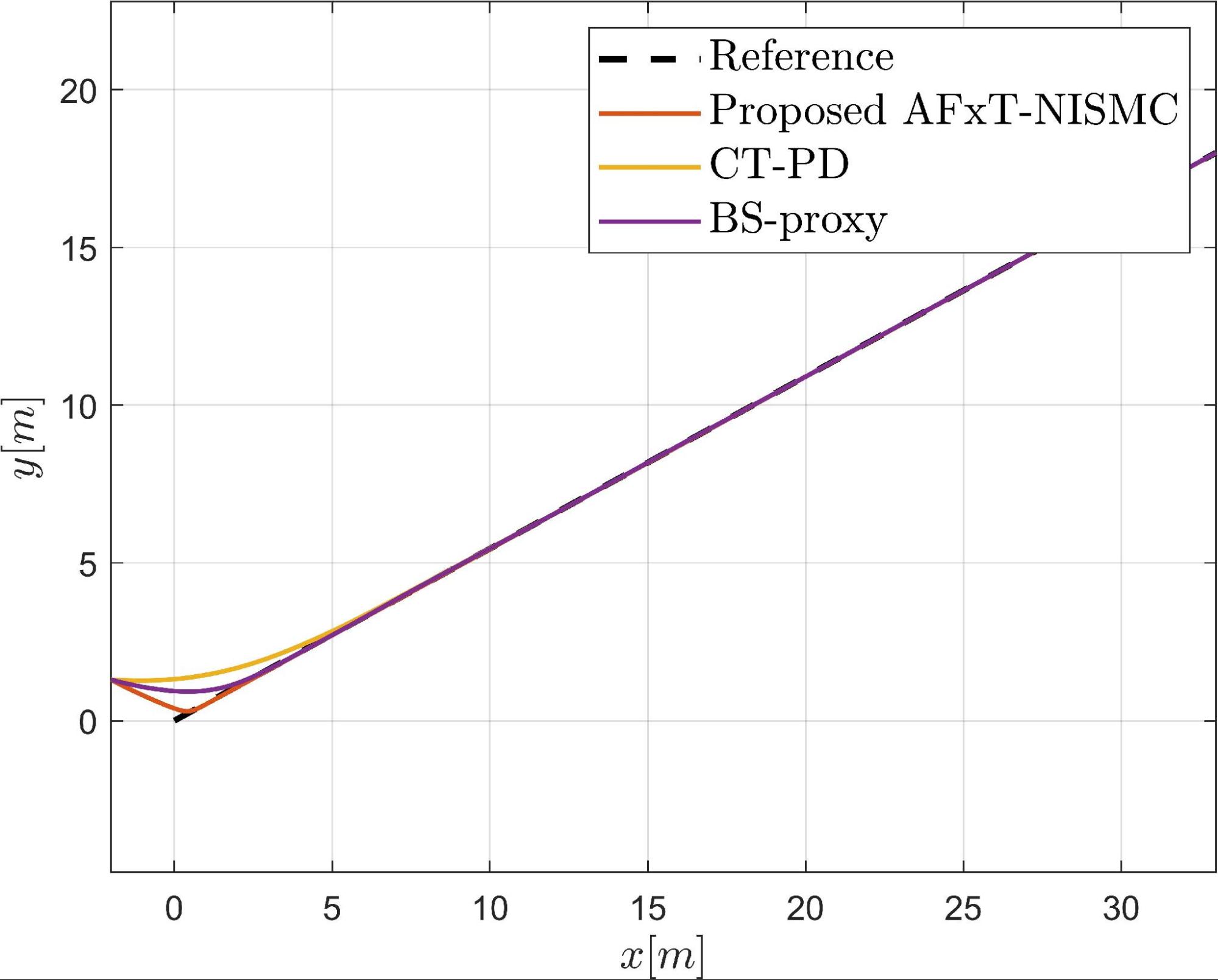
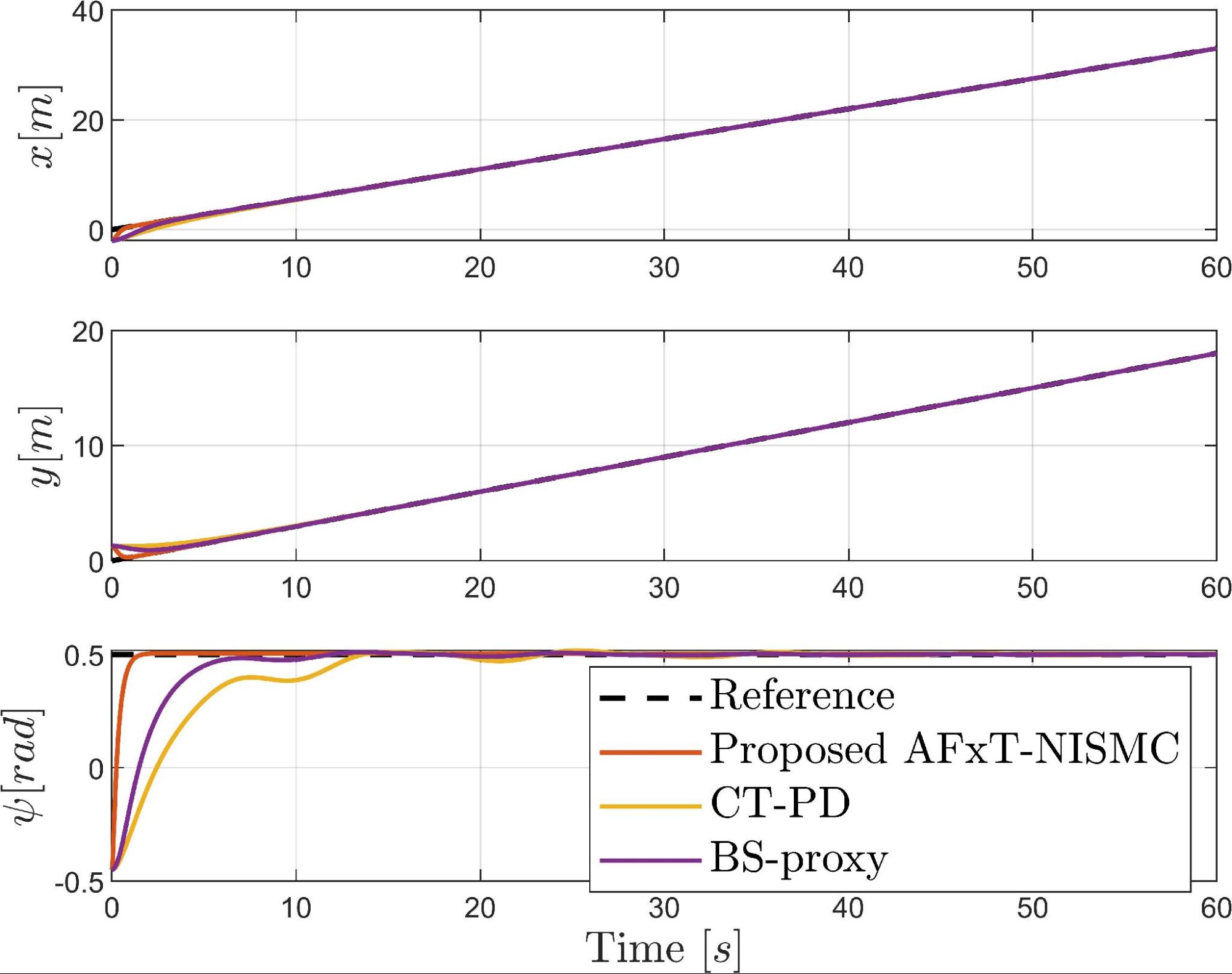
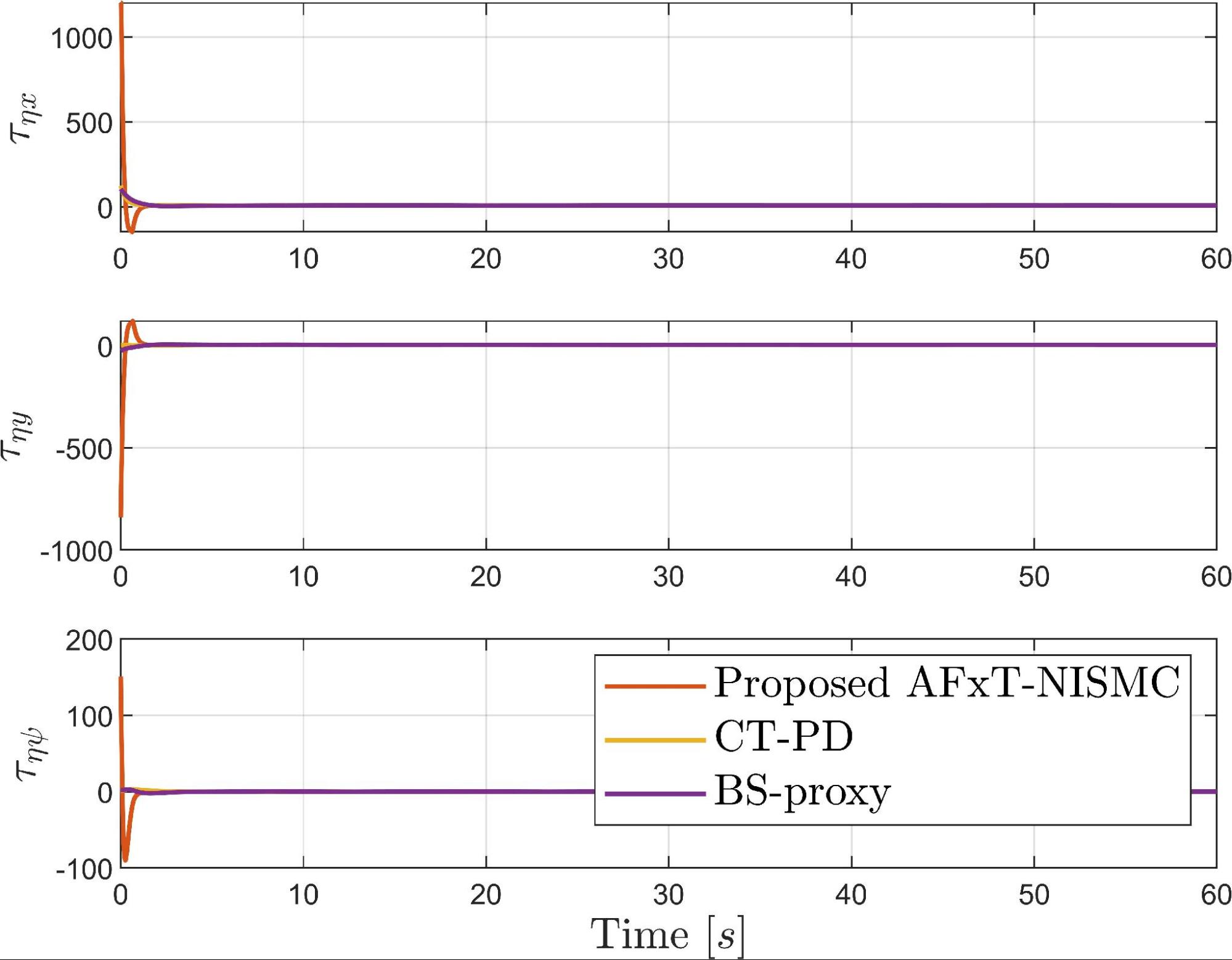
Fig. 7 to Fig. 11 present the simulation results for the straight-line trajectory. The proposed AFxT-NISMC controller accurately tracks the desired line from nonzero initial position and heading errors, whereas CT-PD and BS-proxy exhibit larger transient deviations. The position-heading responses show that the proposed controller reaches the reference signals faster and with less oscillation. The tracking-error plots demonstrate a clear reduction in , , and , confirming improved tracking accuracy in all three motion channels. The tracking-error norm and sliding-variable norm converge rapidly, which is consistent with the rapid practical convergence predicted by Theorem 1. The control-input responses are bounded and practically smooth due to the use of the saturation function instead of the ideal discontinuous sign function. As also shown in Table 3, the proposed method achieves the lowest total RMSE and the shortest settling time among the compared controllers.
Controller |
|
|
|
| IAE | Settling time [s] |
Proposed AFxT-NISMC | 0.1273 | 0.0805 | 0.0543 | 0.1601 | 1.6669 | 0.981 |
CT-PD | 0.3633 | 0.2145 | 0.1722 | 0.4557 | 9.1713 | 12.756 |
BS-proxy | 0.2834 | 0.1563 | 0.1337 | 0.3501 | 4.8271 | 5.052 |
The proposed AFxT-NISMC provides an initial-condition-independent fixed-time guarantee for entry into an explicitly characterized sliding neighborhood when the continuous saturation implementation is used. Consequently, the tracking-error dynamics are uniformly ultimately bounded. Exact fixed-time sliding and asymptotic tracking are recovered only for the ideal sign-based controller under a separate disturbance-dominance condition. In the present nominal simulations, the circular trajectory produced a total tracking-error RMSE of 0.41902 and a settling time of 1.613 s, whereas the straight-line trajectory produced an RMSE of 0.1601 and a settling time of 0.981 s. The study remains limited to simulation of a fully actuated three-degree-of-freedom USV. Systematic variations in initial conditions and model parameters, actuator and thruster dynamics, hard input constraints, measurement noise, communication effects, underactuation, output-feedback implementation, and experimental validation are not considered. These issues form the principal directions for future work.
Hoang Duc Long, Adaptive Fixed-Time Nonlinear Integral Sliding Mode Control for Trajectory Tracking of Unmanned Surface Vehicles under Unknown Disturbances