Imbalance Handling Strategies for Predictive Maintenance Under Leakage-Free Factorial Evaluation
DOI:
https://doi.org/10.59247/jfsc.v4i1.399Keywords:
predictive maintenance, class imbalance, machine learning, SMOTE, XGBoost, cross-validationAbstract
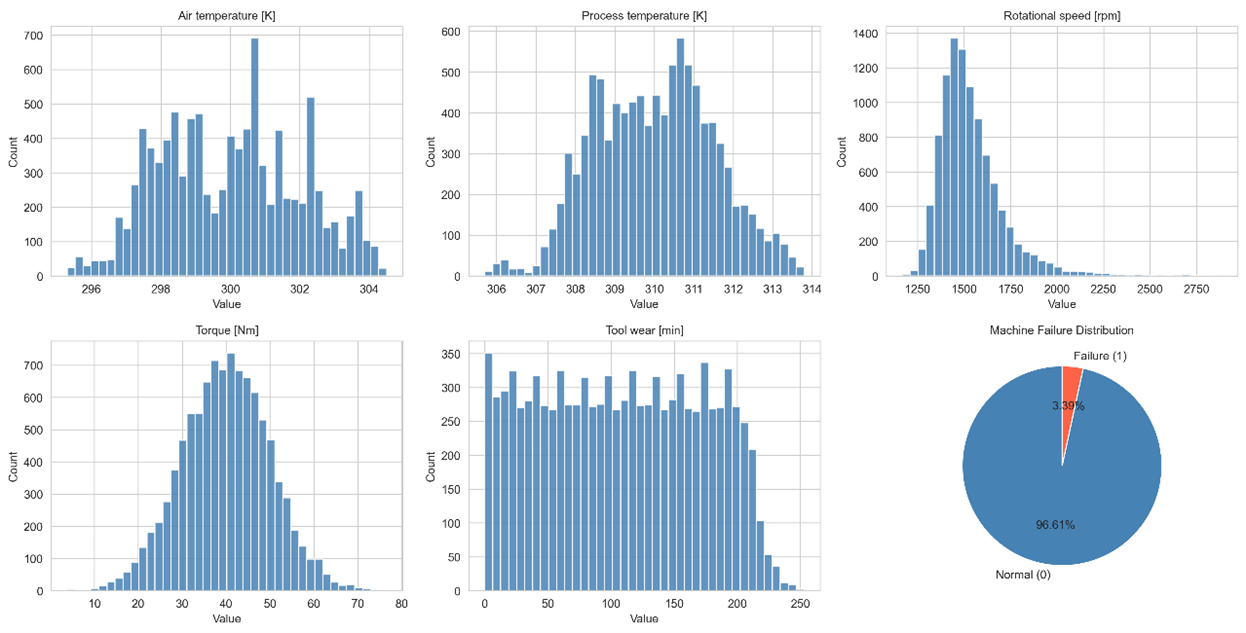
Predictive maintenance (PdM) in industrial manufacturing relies on machine learning classifiers trained on severely imbalanced sensor data, where failure events represent a small minority of observations. This study presents a controlled factorial experiment evaluating five algorithms (Decision Tree, Random Forest, SVM, XGBoost, and Logistic Regression) against four imbalance handling strategies (no handling, SMOTE, ADASYN, and class weighting) across binary and six-class failure mode identification tasks on the AI4I 2020 dataset (10,000 observations, 3.39% failure rate), yielding 40 experimental conditions. All oversampling steps were integrated within an ImbPipeline to prevent data leakage across cross-validation folds. Statistical comparisons were conducted via the Friedman test, post-hoc Nemenyi analysis, and one-tailed Wilcoxon signed-rank tests. XGBoost with no handling achieved the highest performance in both tasks (binary F1 = 0.8952; multiclass F1 = 0.6084). Contrary to common practice, no handling method outperformed SMOTE or ADASYN across four of five algorithms in the binary task (Wilcoxon, p = 0.0312), while class weighting improved macro recall from 0.8448 to 0.8908 without significant F1 degradation. Per-class analysis showed that heat dissipation, power, and overstrain failures were reliably detected (F1 > 0.82), while tool wear and random failures remained undetectable. In the multiclass task, ADASYN and XGBoost class weighting were replaced by SMOTE due to instability with extreme minority classes. These findings demonstrate that synthetic oversampling is not universally beneficial for imbalanced PdM data, and that leakage-free experimental design is essential for reliable performance estimation. Practitioners are advised to benchmark no handling and class weighting before applying synthetic oversampling in PdM deployments.
References
Z. Wu, Y. Guo, W. Lin, S. Yu, and Y. Ji, “A weighted deep representation learning model for imbalanced fault diagnosis in cyber-physical systems,” Sensors (Switzerland), vol. 18, no. 4, p. 1096, 2018, https://doi.org/10.3390/s18041096.
M. Fernandes, J. M. Corchado, and G. Marreiros, “Machine learning techniques applied to mechanical fault diagnosis and fault prognosis in the context of real industrial manufacturing use-cases: a systematic literature review,” Applied Intelligence, vol. 52, no. 12, pp. 14246–14280, 2022, https://doi.org/10.1007/s10489-022-03344-3.
G. Ermachkov and V. Nezevak, “Monitoring the Technical Condition of Traction Substation Equipment using Thermal Imaging Technologies and Machine Vision Methods,” Journal of Fuzzy Systems and Control, vol. 3, no. 1, pp. 1–6, 2024, https://doi.org/10.59247/jfsc.v3i1.270.
E. Jovicic, D. Primorac, M. Cupic, and A. Jovic, “Publicly Available Datasets for Predictive Maintenance in the Energy Sector: A Review,” IEEE Access, vol. 11, pp. 73505–73520, 2023, https://doi.org/10.1109/ACCESS.2023.3295113.
S. Matzka, “Explainable Artificial Intelligence for Predictive Maintenance Applications,” in Proceedings - 2020 3rd International Conference on Artificial Intelligence for Industries, AI4I 2020, Institute of Electrical and Electronics Engineers Inc., 2020, pp. 69–74, https://doi.org/10.1109/AI4I49448.2020.00023.
M. H. Ho et al., “Ensemble learning for multi-label classification with unbalanced classes: A case study of a curing oven in glass wool production,” Mathematics, vol. 11, no. 22, p. 4602, 2023, https://doi.org/10.3390/math11224602.
N. V. Chawla, K. W. Bowyer, L. O. Hall, and W. P. Kegelmeyer, “SMOTE: Synthetic minority over-sampling technique,” Journal of Artificial Intelligence Research, vol. 16, pp. 321–357, 2002, https://doi.org/10.1613/jair.953.
H. He, Y. Bai, E. A. Garcia, and S. Li, “ADASYN: Adaptive synthetic sampling approach for imbalanced learning,” in Proceedings of the International Joint Conference on Neural Networks, Hong Kong, pp. 1322–1328, 2008, https://doi.org/10.1109/IJCNN.2008.4633969.
K. Zheng, G. Jia, L. Yang, and C. Liu, “A cost-sensitive diagnosis method based on the operation and maintenance data of uav,” Applied Sciences (Switzerland), vol. 11, no. 23, p. 11116, 2021, https://doi.org/10.3390/app112311116.
A. Demircioğlu, “Applying oversampling before cross-validation will lead to high bias in radiomics,” Scientific Reports, vol. 14, no. 1, 2024, https://doi.org/10.1038/s41598-024-62585-z.
R. Blagus and L. Lusa, “Joint use of over-and under-sampling techniques and cross-validation for the development and assessment of prediction models,” BMC Bioinformatics, vol. 16, no. 1, 2015, https://doi.org/10.1186/s12859-015-0784-9.
A. S. Tarawneh, A. B. Hassanat, G. A. Altarawneh, and A. Almuhaimeed, “Stop Oversampling for Class Imbalance Learning: A Review,” IEEE Access, vol. 10, pp. 47643–47660, 2022, https://doi.org/10.1109/ACCESS.2022.3169512.
S. Susan and A. Kumar, “The balancing trick: Optimized sampling of imbalanced datasets—A brief survey of the recent State of the Art,” Engineering Reports, vol. 3, no. 4, 2021, https://doi.org/10.1002/eng2.12298.
J. V. Autran, V. Kuhn, J. P. Diguet, M. Dubois, and C. Buche, “AI4I-PMDI: Predictive maintenance datasets with complex industrial settings’ irregularities,” in Procedia Computer Science, Elsevier B.V., pp. 1201–1209, 2024, https://doi.org/10.1016/j.procs.2024.09.546.
H. R. Shah, B. Haley, and E. Abdelfattah, “Application of Machine Learning Models for Predictive Analytics on AI4I 2020,” in 2024 IEEE 15th Annual Ubiquitous Computing, Electronics and Mobile Communication Conference, UEMCON 2024, Institute of Electrical and Electronics Engineers Inc., pp. 506–511, 2024, https://doi.org/10.1109/UEMCON62879.2024.10754668.
Z. M. Çınar, A. A. Nuhu, Q. Zeeshan, O. Korhan, M. Asmael, and B. Safaei, “Machine Learning in Predictive Maintenance towards Sustainable Smart Manufacturing in Industry 4.0,” Sustainability, vol. 12, no. 19, p. 8211, 2020, https://doi.org/10.3390/su12198211.
L. Breiman, “Random forests,” Machine Learning, vol. 45, no. 1, pp. 5–32, 2001, https://doi.org/10.1023/A:1010933404324.
T. Chen and C. Guestrin, “XGBoost: A scalable tree boosting system,” in Proceedings of the ACM SIGKDD International Conference on Knowledge Discovery and Data Mining, San Francisco, CA, USA, pp. 785–794, 2016, https://doi.org/10.1145/2939672.2939785.
C. Cortes and V. Vapnik, “Support-vector networks,” Machine Learning, vol. 20, no. 3, pp. 273–297, 1995, https://doi.org/10.1007/bf00994018.
S. Mählkvist, J. Ejenstam, and K. Kyprianidis, “Cost-Sensitive Decision Support for Industrial Batch Processes,” Sensors, vol. 23, no. 23, p. 9464, 2023, https://doi.org/10.3390/s23239464.
M. D. Dangut, Z. Skaf, and I. K. Jennions, “Handling imbalanced data for aircraft predictive maintenance using the BACHE algorithm,” Applied Soft Computing, vol. 123, p. 108924, 2022, https://doi.org/10.1016/j.asoc.2022.108924.
S. Tripathi, D. Muhr, M. Brunner, H. Jodlbauer, M. Dehmer, and F. Emmert-Streib, “Ensuring the Robustness and Reliability of Data-Driven Knowledge Discovery Models in Production and Manufacturing,” Frontiers in Artificial Intelligence, vol. 4, 2021, https://doi.org/10.3389/frai.2021.576892.
F. D. Frumosu, A. R. Khan, H. Schiøler, M. Kulahci, M. Zaki, and P. Westermann-Rasmussen, “Cost-sensitive learning classification strategy for predicting product failures,” Expert Systems with Applications, vol. 161, p. 113653, 2020, https://doi.org/10.1016/j.eswa.2020.113653.
A. Marco-Rico, I. Fernández-Bello, J. Mateo-Sotos, and P. Marco-Vera, “Machine learning for predicting thrombotic recurrence in antiphospholipid syndrome,” Research and Practice in Thrombosis and Haemostasis, vol. 9, no. 7, p. 103198, 2025, https://doi.org/10.1016/j.rpth.2025.103198.
J. Demšar, “Statistical comparisons of classifiers over multiple data sets,” Journal of Machine Learning Research, vol. 7, pp. 1–30, 2006, https://doi.org/10.5555/1248547.1248548.
F. S. Melícias, T. F. R. Ribeiro, C. Rabadão, L. Santos, and R. L. D. C. Costa, “GPT and Interpolation-Based Data Augmentation for Multiclass Intrusion Detection in IIoT,” IEEE Access, vol. 12, pp. 17945–17965, 2024, https://doi.org/10.1109/ACCESS.2024.3360879.
B. Son et al., “Improved patient mortality predictions in emergency departments with deep learning data-synthesis and ensemble models,” Scientific Reports, vol. 13, no. 1, 2023, https://doi.org/10.1038/s41598-023-41544-0.
J. Agboi et al., “Phishing Website Detection via a Transfer Learning based XGBoost Meta-learner with SMOTE-Tomek,” Journal of Fuzzy Systems and Control, vol. 3, no. 3, pp. 181–189, 2025, https://doi.org/10.59247/jfsc.v3i3.325.
M. Imani, Z. Ghaderpour, M. Joudaki, and A. Beikmohammadi, “The Impact of SMOTE and ADASYN on Random Forest and Advanced Gradient Boosting Techniques in Telecom Customer Churn Prediction,” in 2024 10th International Conference on Web Research, ICWR 2024, Tehran, Iran, pp. 202–209, 2024, https://doi.org/10.1109/ICWR61162.2024.10533320.
K. Hamani, M. Kuchar, M. Kubatko, and S. Kirschner, “Advancements in Induction Motor Fault Diagnosis and Condition Monitoring: A Comprehensive Review,” Sensors, vol. 25, no. 19, p. 5942, 2025, https://doi.org/10.3390/s25195942.
A. Nogales, D. Guadalupe, and Á. J. García-Tejedor, “Self-organizing maps to evaluate optimal strategies for balancing binary class distributions: a methodological approach,” Journal of Big Data, vol. 12, no. 1, p. 141, 2025, https://doi.org/10.1186/s40537-025-01188-5.
J. Chen, C. P. Lim, K. H. Tan, K. Govindan, and A. Kumar, “Artificial intelligence-based human-centric decision support framework: an application to predictive maintenance in asset management under pandemic environments,” Annals of Operations Research, vol. 350, no. 2, pp. 493–516, 2025, https://doi.org/10.1007/s10479-021-04373-w.
Published
How to Cite
Issue
Section
License
Copyright (c) 2026 Tedy Rismawan, Irma Nirmala

This work is licensed under a Creative Commons Attribution-ShareAlike 4.0 International License.
