Dual-Stream MobileNetV2 and Light Mixer Fusion for Robust Weather Classification
DOI:
https://doi.org/10.59247/jfsc.v4i2.406Keywords:
MobileNetV2, Weather Classification, Mixer Branch, Two-Branch Fusion, FPN, Selective AttentionAbstract
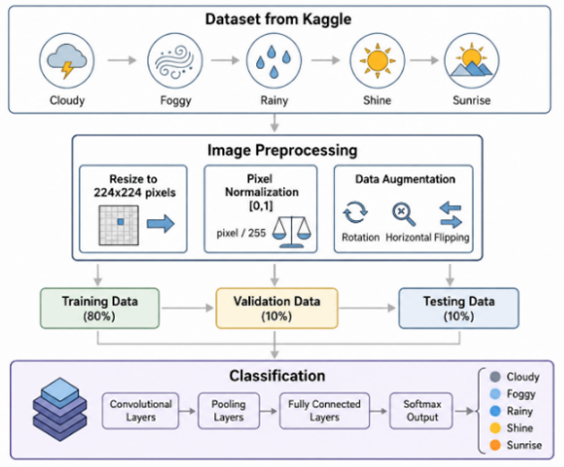
This study proposes an image-based weather classification model designed to accurately recognize various sky conditions, with the aim of providing accessible weather information for elderly individuals and users with visual impairments. While existing lightweight models often struggle to effectively capture both fine-grained local textures and global contextual patterns, this study bridges the gap by proposing a hybrid dual-branch architecture. Specifically, the proposed model utilizes an early spatial feature-level fusion dual-branch architecture. The first branch combines MobileNetV2 with a Feature Pyramid Network (FPN) and incorporates selective attention mechanisms to capture multi-scale features. The second branch, referred to as the Mixer branch, improves visual feature representation through patch embedding and feature mixing techniques. Outputs from both branches are integrated using a fusion layer before being processed by a softmax classifier. The dataset includes five weather categories: cloudy, foggy, rainy, sunny, and sunrise, and is preprocessed through normalization, data augmentation, and partitioning into training, validation, and testing sets. Model training is conducted using TensorFlow and Keras with the Adam optimizer over a two-phase training schedule of 60 epochs (20 epochs for head-only pre-training and 40 epochs for whole-model fine-tuning). The experimental evaluation achieves a test accuracy of 0.975 (97.50%), with precision, recall, and F1-score reaching 0.976, 0.975, and 0.975, respectively, reflecting consistent and reliable classification performance. These results indicate that the proposed model has strong potential for integration with text-to-speech systems to improve accessibility of weather information for users with special needs.
References
W. Zhang and W. Li, “How weather conditions affect well-being: an explanation from the perspective of environmental psychology,” Frontiers in Public Health, vol. 13, 2025, https://doi.org/ 10.3389/fpubh.2025.1553315.
M. Romanello et al., “The 2023 report of the lancet countdown on health and climate change: the imperative for a health-centred response in a world facing irreversible harms,” The Lancet, vol. 402, no. 10419, pp. 2346–2394, 2023, https://doi.org/ 10.1016/S0140-6736(23)01859-7.
A. Patil and S. Raghani, “Designing accessible and independent living spaces for visually impaired individuals: a barrier-free approach to interior design,” International Journal for Equity in Health, vol. 24, no. 1, p. 137, 2025, https://doi.org/ 10.1186/s12939-025-02503-5.
V. S. A. Hendrawan, A. P. Rahardjo, H. G. Mawandha, E. Aldrian, A. Muhari, and D. Komori, “Past and future climate-related hazards in Indonesia,” Egusphere, no. 584. pp. 1–34, 2025, https://doi.org/ 10.5194/egusphere-2025-584.
J. J. Kunda, S. N. Gosling, and G. M. Foody, “The effects of extreme heat on human health in tropical Africa,” International Journal of Biometeorology, vol. 68, no. 6, pp. 1015–1033, 2024, https://doi.org/ 10.1007/s00484-024-02650-4.
N. Permatasari, E. Y. Yovi, and B. Kuncahyo, “Mitigating Heat Exposure: Exploring the Role of Knowledge, Risk Perception, and Precautionary Behavior,” Jurnal Sylva Lestari, vol. 12, no. 1, pp. 11–26, 2024, https://doi.org/ 10.23960/jsl.v12i1.773.
N. Shelke, S. Maurya, R. Ithape, Z. Shaikh, R. Somkunwar, and A. Pimpalkar, “Towards an automated weather forecasting and classification using deep learning, fully convolutional network, and long short-term memory,” International Journal of Electrical and Computer Engineering (IJECE), vol. 15, no. 2, p. 1868, 2025, https://doi.org/ 10.11591/ijece.v15i2.pp1868-1879.
X. Zhao, L. Wang, Y. Zhang, X. Han, M. Deveci, and M. Parmar, “A review of convolutional neural networks in computer vision,” Artificial Intelligence Review, vol. 57, no. 4, p. 99, 2024, https://doi.org/ 10.1007/s10462-024-10721-6.
A. I. Putri, Y. Syarif, N. R. Aisyi, and N. Waeyusoh, “Implementation of gated recurrent unit, long short-term memory and derivatives for gold price prediction,” Public Research Journal of Engineering, Data Technology and Computer Science, vol. 2, no. 2, pp. 68–80, 2025, https://doi.org/ 10.57152/predatecs.v2i2.1609.
K. R. Ariawan, A. A. G. Ekayana, I. P. Y. Indrawan, K. R. Winatha, and I. N. A. F. Setiawan, “Performance Comparasion of DenseNet-121 and MobileNetV2 for Cacao Fruit Disease Image Classification,” Indonesian Journal of Data and Science, vol. 6, no. 1, pp. 30–38, 2025, https://doi.org/ 10.56705/ijodas.v6i1.233.
R. Indraswari, R. Rokhana, and W. Herulambang, “Melanoma image classification based on MobileNetV2 network,” Procedia Computer Science, vol. 197, pp. 198–207, 2021, https://doi.org/ 10.1016/j.procs.2021.12.132.
P. T. Huong, L. T. Hien, N. M. Son, H. C. Tuan, and T. Q. Nguyen, “Enhancing deep convolutional neural network models for orange quality classification using MobileNetV2 and data augmentation techniques,” Journal of Algorithms and Computational Technology, vol. 19, 2025, https://doi.org/ 10.1177/17483026241309070.
M. A. Mutasodirin and F. M. Falakh, “Efficient Weather Classification Using DenseNet and EfficientNet,” Jurnal Informatika: Jurnal Pengembangan IT, vol. 9, no. 2, pp. 173–179, 2024, https://doi.org/ 10.30591/jpit.v9i2.7539.
H. Tarwani, S. Patel, and P. Goel, “Deep learning approach for weather classification using pre-trained convolutional neural networks,” Procedia Computer Science, vol. 252, pp. 136–145, 2025, https://doi.org/ 10.1016/j.procs.2024.12.015.
J. Kim, O. Hayeon, Y. Oh, K. An, and D. Lee, “SADWA: fine-grained weather awareness with vision-language models for seamless autonomous driving in real time,” in Proceedings - 2025 IEEE/CVF International Conference on Computer Vision Workshops, ICCV-W 2025, IEEE, pp. 832–841, 2025, https://doi.org/ 10.1109/ICCVW69036.2025.00091.
Y. Jiao et al., “Swin-HSSAM: A green coffee bean grading method by Swin transformer,” PLoS ONE, vol. 20, no. 5, p. e0322198, 2025, https://doi.org/ 10.1371/journal.pone.0322198.
I. Tolstikhin et al., “MLP-Mixer: An all-MLP Architecture for Vision,” Advances in Neural Information Processing Systems, vol. 29. pp. 24261–24272, 2021, https://doi.org/ 10.48550/arXiv.2105.01601.
H. Lyu, Y. Wang, Y. A. Tan, H. Zhou, Y. Zhao, and Q. Zhang, “Maxwell’s Demon in MLP-Mixer: towards transferable adversarial attacks,” Cybersecurity, vol. 7, no. 1, p. 6, 2024, https://doi.org/ 10.1186/s42400-023-00196-3.
A. Wicaksono, I. P. E. N. Kencana, and I W. Sumarjaya, “Image Classification Comparison Using Neural Network and Support Vector Machine Algorithm With VGG16 As Feature Extraction Method,” International Journal of Applied Mathematics and Computing, vol. 1, no. 3, pp. 41–52, 2024, https://doi.org/ 10.62951/ijamc.v1i3.29.
S. R. Stahlschmidt, B. Ulfenborg, and J. Synnergren, “Multimodal deep learning for biomedical data fusion: A review,” Briefings in Bioinformatics, vol. 23, no. 2, 2022, https://doi.org/ 10.1093/bib/bbab569.
S. R. Yang, H. C. Yang, F. R. Shen, and J. Zhao, “Image Data Augmentation for Deep Learning: A Survey,” Ruan Jian Xue Bao/Journal of Software, vol. 36, no. 3. pp. 1390–1412, 2025. https://doi.org/ 10.13328/j.cnki.jos.007263.
R. Yousaf et al., “Satellite imagery-based cloud classification using deep learning,” Remote Sensing, vol. 15, no. 23, p. 5597, 2023, https://doi.org/ 10.3390/rs15235597.
B. İşler, Ş. M. Kaya, and F. R. Kılıç, “Fog-enabled machine learning approaches for weather prediction in IoT Systems: A case study,” Sensors, vol. 25, no. 13, p. 4070, 2025, https://doi.org/ 10.3390/s25134070.
A. P. Atmaja, S. K. Bimonugroho, and M. H. R. Ismar, “Implementation of an Indonesian AI-based text-to-speech system for self-student pickup announcements based on natural language processing,” Journal of Applied Research and Technology, vol. 23, no. 2, pp. 155–163, 2025, https://doi.org/ 10.22201/icat.24486736e.2025.23.2.2605.
Published
How to Cite
Issue
Section
License
Copyright (c) 2026 Muhammad Reza Alfatah, Hadi Santoso

This work is licensed under a Creative Commons Attribution-ShareAlike 4.0 International License.

This journal is licensed under a Creative Commons Attribution-ShareAlike 4.0 International License.
