Hybrid GA-GWO with Dual-Vector Encoding for Indonesian School Timetabling
DOI:
https://doi.org/10.59247/jfsc.v4i2.418Keywords:
School Timetabling, Genetic Algorithms, Grey Wolf Optimizer, Hybrid Metaheuristic, Constraint OptimizationAbstract
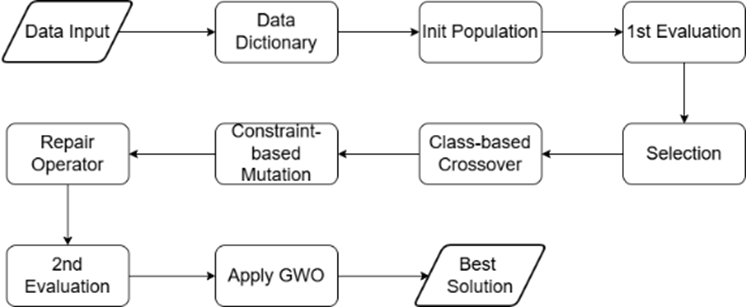
School timetabling is a complex combinatorial optimization problem that involves assigning subjects, teachers, and classes to predefined time slots while satisfying numerous institutional constraints. In many Indonesian junior high schools, scheduling is still performed using manual approaches, which are often time-consuming and prone to conflicts. Compared with university timetabling, school timetabling presents additional challenges due to fixed class groups, rigid subject allocations, teacher availability constraints, and institutional regulations. To address these challenges, this study proposes a hybrid optimization framework that combines a Guided Genetic Algorithm (GA) and Grey Wolf Optimizer (GWO) for the school timetable. The proposed framework incorporates dual-vector solution encoding to provide a structured representation of scheduling components and support efficient constraint handling during the optimization process. In addition, a majority-voting and guided mutation strategy is employed to enhance the balance between exploration and exploitation. The proposed method was evaluated using real-world scheduling data from an Indonesian junior high school consisting of 27 classes, 54 teachers, 13 subjects, and 36 time slots. Experimental results show that the proposed hybrid GA-GWO achieved a fitness improvement of 95.84%, reducing the fitness value from 16,120 to 670, compared with improvements of 89.83% and 94.31% obtained by Traditional GA and Guided GA, respectively. Although the proposed method required approximately 28 minutes of execution time, it produced the highest overall timetable quality among the evaluated approaches. These findings demonstrate that the integration of dual-vector encoding, majority voting, and guided mutation within a hybrid GA-GWO framework can effectively improve timetable optimization for real-world Indonesian school scheduling environments.
References
N. Pillay, “A survey of school timetabling research,” Annals of Operations Research, vol. 218, no. 1, pp. 261–293, 2014, https://doi.org/10.1007/s10479-013-1321-8.
I. Gusti Agung Premananda, A. Tjahyanto, and A. Muklason, “Timetabling Problems and the Effort Toward Generic Algorithms: A Comprehensive Survey,” IEEE Access, vol. 12, pp. 143854–143868, 2024, https://doi.org/10.1109/ACCESS.2024.3463721.
S. Ceschia, L. Di Gaspero, and A. Schaerf, “Educational timetabling: Problems, benchmarks, and state-of-the-art results,” European Journal of Operational Research, vol. 308, no. 1, pp. 1–18, 2023, https://doi.org/10.1016/j.ejor.2022.07.011.
A. Schaerf, “Survey of automated timetabling,” Artificial Intelligence Review, vol. 13, no. 2, pp. 87–127, 1999, https://doi.org/10.1023/A:1006576209967.
M. Kaur and S. Saini, “A review of metaheuristic techniques for solving university course timetabling problem,” in Lecture Notes in Networks and Systems, vol. 135, V. Goar, M. Kuri, R. Kumar, and T. Senjyu, Eds., Springer, pp. 19–25, 2021, https://doi.org/10.1007/978-981-15-5421-6_3.
R. Hoshino and I. Fabris, “Optimizing Student Course Preferences in School Timetabling,” in Lecture Notes in Computer Science (including subseries Lecture Notes in Artificial Intelligence and Lecture Notes in Bioinformatics), E. Hebrard and N. Musliu, Eds., Springer, pp. 283–299, 2020, https://doi.org/10.1007/978-3-030-58942-4_19.
J. S. Tan, S. L. Goh, G. Kendall, and N. R. Sabar, “A survey of the state-of-the-art of optimisation methodologies in school timetabling problems,” Expert Systems with Applications, vol. 165, p. 113943, 2021, https://doi.org/10.1016/j.eswa.2020.113943.
X. Gu, M. Krish, S. Sohail, S. Thakur, F. Sabrina, and Z. Fan, “From Integer Programming to Machine Learning: A Technical Review on Solving University Timetabling Problems,” Computation, vol. 13, no. 1, p. 10, 2025, https://doi.org/10.3390/computation13010010.
P. T. Nsulangi, W. E. Ngongi, M. R. Likamba, O. B. Sarehe, and M. A. Mkwande, “A Comparative Analysis of Manual and Automatic Timetabling Approaches for Resource Utilisation in Tertiary Higher Learning Institution,” International Journal of Computer Science and Mobile Computing, vol. 13, no. 12, pp. 65–76, 2024, https://doi.org/10.47760/ijcsmc.2024.v13i12.007.
T. Birbas, S. Daskalaki, and E. Housos, “School timetabling for quality student and teacher schedules,” Journal of Scheduling, vol. 12, no. 2, pp. 177–197, 2009, https://doi.org/10.1007/s10951-008-0088-2.
R. Saltos and S. Maldonado, “School Timetabling Problem: A Scheduling Problem for High-School Institutions,” INFORMS Transactions on Education, vol. 24, no. 1, pp. 95–99, 2023, https://doi.org/10.1287/ited.2022.0276ca.
M. H. Cruz-Rosales et al., “Metaheuristic with Cooperative Processes for the University Course Timetabling Problem,” Applied Sciences (Switzerland), vol. 12, no. 2, p. 542, 2022, https://doi.org/10.3390/app12020542.
A. R. Mahlous and H. Mahlous, “Student timetabling genetic algorithm accounting for student preferences,” PeerJ Computer Science, vol. 9, p. e1200, 2023, https://doi.org/10.7717/peerj-cs.1200.
R. P. Badoni et al., “An Exploration and Exploitation-Based Metaheuristic Approach for University Course Timetabling Problems,” Axioms, vol. 12, no. 8, 2023, https://doi.org/10.3390/axioms12080720.
M. Davison, G. Burgess, R. Hamm, B. Lowery, and A. Page, “A parallelised hyper-heuristic framework for the Integrated Healthcare Timetabling Competition 2024,” SSRN, 2025, https://doi.org/10.2139/ssrn.5601273.
B. Alhijawi and A. Awajan, “Genetic algorithms: theory, genetic operators, solutions, and applications,” Evolutionary Intelligence, vol. 17, no. 3, pp. 1245–1256, 2024, https://doi.org/10.1007/s12065-023-00822-6.
T. Alam, S. Qamar, A. Dixit, and M. Benaida, “Genetic algorithm: Reviews, implementations and applications,” International Journal of Engineering Pedagogy, vol. 10, no. 6, pp. 57–77, 2021, https://doi.org/10.3991/IJEP.V10I6.14567.
J. H. Holland, Adaptation in Natural and Artificial Systems. Ann Arbor: University of Michigan Press, 1992, https://doi.org/10.7551/mitpress/1090.001.0001.
M. H. Hashem, H. S. Abdullah, and K. I. Ghathwan, “Grey Wolf Optimization Algorithm: A Survey,” Iraqi Journal of Science, vol. 64, no. 11, pp. 5964–5984, 2023, https://doi.org/10.24996/ijs.2023.64.11.40.
B. Li and X. Xia, “A Self-Adjusting Search Domain Method-Based Genetic Algorithm for Solving Flexible Job Shop Scheduling Problem,” Computational Intelligence and Neuroscience, vol. 2022, 2022, https://doi.org/10.1155/2022/4212556.
K. Sarra, Z. Djamel, and M. Smaine, “A Novel Method for Solving the University Course Timetabling Problem Based on the Grey Wolf Optimizer Algorithm,” in 2023 3rd International Conference on Theoretical and Applicative Aspects of Computer Science, ICTAACS 2023, pp. 1–8, 2023, https://doi.org/10.1109/ICTAACS60400.2023.10449623.
K. Li, S. Li, Z. Huang, M. Zhang, and Z. Xu, “Grey Wolf Optimization algorithm based on Cauchy-Gaussian mutation and improved search strategy,” Scientific Reports, vol. 12, no. 1, 2022, https://doi.org/10.1038/s41598-022-23713-9.
I. A. Abduljabbar and S. M. Abdullah, “An evolutionary algorithm for solving academic courses timetable scheduling problem,” Baghdad Science Journal, vol. 19, no. 2, pp. 399–408, 2022, https://doi.org/10.21123/BSJ.2022.19.2.0399.
Q. Zhang, “An optimized solution to the course scheduling problem in universities under an improved genetic algorithm,” Journal of Intelligent Systems, vol. 31, no. 1, pp. 1065–1073, 2022, https://doi.org/10.1515/jisys-2022-0114.
H. Erdoğan Akbulut, F. Özçelik, and T. Saraç, “A simulated annealing algorithm for the faculty-level university course timetabling problem,” Pamukkale University Journal of Engineering Sciences, vol. 30, no. 1, pp. 17–30, 2024, https://doi.org/10.5505/pajes.2023.00483.
H. Yan, Z. Cui, X. Chen, and X. Ma, “Distributed Multiagent Deep Reinforcement Learning for Multiline Dynamic Bus Timetable Optimization,” IEEE Transactions on Industrial Informatics, vol. 19, no. 1, pp. 469–479, 2023, https://doi.org/10.1109/TII.2022.3158651.
X. Han and D. Wang, “Gradual Optimization of University Course Scheduling Problem Using Genetic Algorithm and Dynamic Programming,” Algorithms, vol. 18, no. 3, 2025, https://doi.org/10.3390/a18030158.
D. Abramson, “Constructing school timetables using simulated annealing. Sequential and parallel algorithms,” Management Science, vol. 37, no. 1, pp. 98–113, 1991, https://doi.org/10.1287/mnsc.37.1.98.
Published
How to Cite
Issue
Section
License
Copyright (c) 2026 Akbar Muhammad Sadat, Alqis Rausanfita, Pima Hani Safitri

This work is licensed under a Creative Commons Attribution-ShareAlike 4.0 International License.

This journal is licensed under a Creative Commons Attribution-ShareAlike 4.0 International License.
