Comparative Analysis of PI Anti-Windup and Adaptive Fuzzy PID for Output Voltage Control of a Non-Inverting Buck-Boost DC-DC Converter
DOI:
https://doi.org/10.59247/jfsc.v4i3.461Keywords:
Adaptive Fuzzy PID, Anti-Windup PI, Buck-Boost Non-Inverting, Dynamic Response, Voltage ControlAbstract
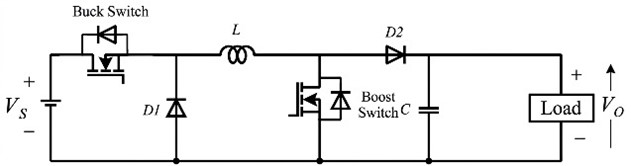
Buck-Boost Non-Inverting DC-DC converters are widely used in DC power supply and battery-based systems because they can raise or lower the output voltage without reversing the output polarity. However, the converter's nonlinear characteristics make voltage control more complex, especially when the load or set point changes. This study compares the performance of two voltage control strategies, namely Proportional-Integral Anti-Windup (PI-AW) and Adaptive Fuzzy PID (AFPID), on DC-DC Buck-Boost Non-Inverting converters. The system is designed to operate in buck mode with an output voltage of 12 V and boost mode with an output voltage of 24 V from a 15 V input voltage source, using a load variation of 100–300 Ω and a switching frequency of 30 kHz. Evaluation was carried out through PSIM simulation and ESP32-based hardware implementation, with test scenarios including fixed set points, set-point changes, and load changes. The test results showed that both methods adjusted the output voltage to follow the reference value under all test conditions. However, the Anti-Windup PI performed better than the Adaptive Fuzzy PID, with faster rise times, lower overshoot and steady-state errors, shorter settling times, and smaller voltage ripples in buck and boost modes. The results show that PI Anti-Windup is more suitable for DC-DC Buck-Boost Non-Inverting converters that require fast transient response and high output-voltage stability.
References
K. Salitha, H. A. Vidya, and J. Ramprabhakar, “Advancement of Power Electronic Converter and Control Methods in Microgrid Systems: A Review,” IEEE Access, vol. 14, pp. 4402–4434, 2026, https://doi.org/10.1109/ACCESS.2025.3650614.
S. Prasad, K. Ranawat, P. Prabhakaran, and A. Dominic, “A Novel Switched Capacitor-Based Dual-Input Converter for Solar PV and Battery Interface,” IEEE Journal of Emerging and Selected Topics in Power Electronics, vol. 13, no. 6, pp. 6863–6876, 2025, https://doi.org/10.1109/JESTPE.2025.3565215.
B. Chandrasekar et al., “Non-Isolated High-Gain Triple Port DC-DC Buck-Boost Converter with Positive Output Voltage for Photovoltaic Applications,” IEEE Access, vol. 8, pp. 113649–113666, 2020, https://doi.org/10.1109/ACCESS.2020.3003192.
W. Han, T. Wik, A. Kersten, G. Dong, and C. Zou, “Next-Generation Battery Management Systems: Dynamic Reconfiguration,” IEEE Industrial Electronics Magazine, vol. 14, no. 4, pp. 20–31, 2020, https://doi.org/10.1109/MIE.2020.3002486.
X. Weng, Z. Zhao, K. Chen, L. Yuan, and Y. Jiang, “A Nonlinear Control Method for Bumpless Mode Transition in Noninverting Buck-Boost Converter,” IEEE Transactions on Power Electronics, vol. 36, no. 2, pp. 2166–2178, 2021, https://doi.org/10.1109/TPEL.2020.3007600.
G. Chen and K. H. Loo, “Voltage Gain-Based Control for Four-Switch Buck-Boost Converter Exhibiting Fast Dynamic Response Over Wide Output Voltage and Load Range,” IEEE Transactions on Power Electronics, vol. 41, no. 7, pp. 12016–12030, 2026, https://doi.org/10.1109/TPEL.2026.3659103.
A. C. Handika, S. M. Ilman, F. A. S. Putra, Y. S. Halomoan, G. V. Pratama, and M. N. Ar-Rabbani, “Voltage Control on Non-Inverting Buck-Boost DC-DC Converter with the Digital PI Method,” JTEIN: Jurnal Teknik Elektro Indonesia, vol. 7, no. 1, pp. 13–24, 2026, https://doi.org/10.24036/jtein.v7i1.798.
A. Russo, G. P. Incremona, R. Seeber, and A. Ferrara, “Adaptive Bounded Integral Control with Enhanced Anti-Windup Design,” IEEE Control Systems Letters, vol. 7, pp. 1861–1866, 2023, https://doi.org/10.1109/LCSYS.2023.3282378.
B. Sarsembayev, K. Suleimenov, and T. D. Do, “High Order Disturbance Observer Based PI-PI Control System with Tracking Anti-Windup Technique for Improvement of Transient Performance of PMSM,” IEEE Access, vol. 9, pp. 66323–66334, 2021, https://doi.org/10.1109/ACCESS.2021.3074661.
N. W. Madebo, “Enhancing Intelligent Control Strategies for UAVs: A Comparative Analysis of Fuzzy Logic, Fuzzy PID, and GA-Optimized Fuzzy PID Controllers,” IEEE Access, vol. 13, pp. 16548–16563, 2025, https://doi.org/10.1109/ACCESS.2025.3532743.
A. Laib, B. Talbi, A. Krama, and M. Gharib, “Hybrid Interval Type-2 Fuzzy PID+I Controller for a Multi-DOF Oilwell Drill-String System,” IEEE Access, vol. 10, pp. 67262–67275, 2022, https://doi.org/10.1109/ACCESS.2022.3185021.
A. Rodriguez-Lorente, A. Barrado, C. Calderon, C. Fernandez, and A. Lazaro, “Non-inverting and Non-isolated Magnetically Coupled Buck-Boost Bidirectional DC-DC Converter,” IEEE Transactions on Power Electronics, vol. 35, no. 11, pp. 11942–11954, 2020, https://doi.org/10.1109/TPEL.2020.2984202.
M. A. B. Kumar and V. Krishnasamy, “A Single-Switch Continuous Input Current Buck-Boost Converter With Noninverted Output Voltage,” IEEE Transactions on Power Electronics, vol. 38, no. 2, pp. 2181–2190, 2023, https://doi.org/10.1109/TPEL.2022.3215179.
J. Moon et al., “60-V Non-Inverting Four-Mode Buck-Boost Converter with Bootstrap Sharing for Non-Switching Power Transistors,” IEEE Access, vol. 8, pp. 208221–208231, 2020, https://doi.org/10.1109/ACCESS.2020.3038444.
M. Martinez-Lopez, M. Cucuzzella, J. M. Guerrero, and J. Moreno-Valenzuela, “Anti-Windup Adaptive PID Control for Trajectory Tracking in Input-Constrained Power Converters,” IEEE Control Systems Letters, vol. 9, pp. 2187–2192, 2025, https://doi.org/10.1109/LCSYS.2025.3597926.
H. B. Shin and J. G. Park, “Anti-windup PID controller with integral state predictor for variable-speed motor drives,” IEEE Transactions on Industrial Electronics, vol. 59, no. 3, pp. 1509–1516, 2012, https://doi.org/10.1109/TIE.2011.2163911.
A. J. Prado, M. Herrera, X. Dominguez, J. Torres, and O. Camacho, “Integral Windup Resetting Enhancement for Sliding Mode Control of Chemical Processes with Longtime Delay,” Electronics (Switzerland), vol. 11, no. 24, p. 4220, 2022, https://doi.org/10.3390/electronics11244220.
M. A. A. Murad and F. Milano, “Modeling and Simulation of PI-Controllers Limiters for the Dynamic Analysis of VSC-Based Devices,” IEEE Transactions on Power Systems, vol. 34, no. 5, pp. 3921–3930, 2019, https://doi.org/10.1109/TPWRS.2019.2911034.
Y. J. Lee, A. Khaligh, and A. Emadi, “A compensation technique for smooth transitions in non-inverting buck-boost converter,” in Conference Proceedings - IEEE Applied Power Electronics Conference and Exposition - APEC, Washington, DC, USA, 2009, pp. 608–614, https://doi.org/10.1109/APEC.2009.4802721.
R. G. Kanojiya and P. M. Meshram, “Optimal tuning of PI controller for speed control of DC motor drive using particle swarm optimization,” in 2012 International Conference on Advances in Power Conversion and Energy Technologies, APCET 2012, Mylavaram, India, pp. 1–6, 2012, https://doi.org/10.1109/APCET.2012.6302000.
M. H. Azam, M. H. Hasan, S. Hassan, and S. J. Abdulkadir, “A Novel Approach to Generate Type-1 Fuzzy Triangular and Trapezoidal Membership Functions to Improve the Classification Accuracy,” Symmetry, vol. 13, no. 10, p. 1932, Oct. 2021, https://doi.org/10.3390/sym13101932.
Z. J. Zhou, G. Y. Hu, C. H. Hu, C. L. Wen, and L. L. Chang, “A Survey of Belief Rule-Base Expert System,” IEEE Transactions on Systems, Man, and Cybernetics: Systems, vol. 51, no. 8, pp. 4944–4958, 2021, https://doi.org/10.1109/TSMC.2019.2944893.
Sunardi, A. Yudhana, and Furizal, “Tsukamoto Fuzzy Inference System on Internet of Things-Based for Room Temperature and Humidity Control,” IEEE Access, vol. 11, pp. 6209–6227, 2023, https://doi.org/10.1109/ACCESS.2023.3236183.
M. Whitby, L. Cardelli, M. Kwiatkowska, L. Laurenti, M. Tribastone, and M. Tschaikowski, “PID Control of Biochemical Reaction Networks,” IEEE Transactions on Automatic Control, vol. 67, no. 2, pp. 1023–1030, 2022, https://doi.org/10.1109/TAC.2021.3062544.
D. Wu, R. Peng, and J. M. Mendel, “Type-1 and Interval Type-2 Fuzzy Systems [AI- eXplained],” IEEE Computational Intelligence Magazine, vol. 18, no. 1, pp. 81–83, 2023, https://doi.org/10.1109/MCI.2022.3223496.
S. H. Khairuddin, M. H. Hasan, M. A. Hashmani, and M. H. Azam, “Generating clustering-based interval fuzzy type-2 triangular and trapezoidal membership functions: A structured literature review,” Symmetry, vol. 13, no. 2, pp. 1–25, 2021, https://doi.org/10.3390/sym13020239.
Q. A. Tarbosh et al., “Review and Investigation of Simplified Rules Fuzzy Logic Speed Controller of High Performance Induction Motor Drives,” IEEE Access, vol. 8, pp. 49377–49394, 2020, https://doi.org/10.1109/ACCESS.2020.2977115.
N. G and K. J, “Performance comparison between PID and Fuzzy logic controllers for the hardware implementation of traditional high voltage DC-DC boost converter,” Heliyon, vol. 10, no. 17, p. e36750, Sep. 2024, https://doi.org/10.1016/j.heliyon.2024.e36750.
A. H. A. Adam et al., “Power Decoupling Enhancement of a Triple Active Bridge Converter with Feedforward Compensation Based on Model Predictive Control and Fuzzy Logic Controller in DC Microgrid Systems,” IEEE Access, vol. 12, pp. 140310–140328, 2024, https://doi.org/10.1109/ACCESS.2024.3469815.
J. Pakdeeto, S. Wansungnoen, K. Areerak, and K. Areerak, “Optimal Speed Controller Design of Commercial BLDC Motor by Adaptive Tabu Search Algorithm,” IEEE Access, vol. 11, pp. 79710–79720, 2023, https://doi.org/10.1109/ACCESS.2023.3300233.
M. A. George, D. V. Kamat, and C. P. Kurian, “Electronically Tunable ACO Based Fuzzy FOPID Controller for Effective Speed Control of Electric Vehicle,” IEEE Access, vol. 9, pp. 73392–73412, 2021, https://doi.org/10.1109/ACCESS.2021.3080086.
J. Sarathi and D. Rama Prabha, “An Effective ANFIS Approach for Interconnected DFIG-Based Wind Energy System With Model-In-Loop Validation,” IEEE Access, vol. 13, pp. 77147–77164, 2025, https://doi.org/10.1109/ACCESS.2025.3565073.
Published
How to Cite
Issue
Section
License
Copyright (c) 2026 Sofyan Muhammad Ilman Ilman, Febi Ariefka Putra, Rafly Heriansyah, Toha Rohimat, Toto Tohir, Giga Verian Pratama Pratama, Muhammad Nuruddin Ar-Rabbani

This work is licensed under a Creative Commons Attribution-ShareAlike 4.0 International License.

This journal is licensed under a Creative Commons Attribution-ShareAlike 4.0 International License.
