A Multi-Channel Wavelet Long Short-Term Memory Framework for Early Wheel Slip Detection in Urban Light Rail Transit
DOI:
https://doi.org/10.59247/jfsc.v4i2.419Keywords:
Continuous Wavelet Transform, Deep Learning, Light Rail Transit, Long Short-Term Memory, Predictive Maintenance, Wheel Slip DetectionAbstract
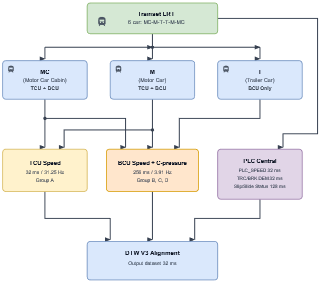
This paper presents an integrated framework combining Continuous Wavelet Transform (CWT) with multi-stream Long Short-Term Memory and Multi-Layer Perceptron (LSTM+MLP) networks for early wheel slip detection in urban Light Rail Transit (LRT). Conventional Wheel Slip Protection (WSP) systems rely on static thresholds applied to axle speed differences, resulting in detection latency that impacts wheel-rail wear and operational disruptions. Three methodological contributions are proposed: (i) a five-channel CWT feature extraction strategy that leverages the structural hierarchy of LRT trainsets consisting of motor car with cabin (MC), motor car (M), and trailer car (T); (ii) a conventional ground truth labeling workflow using Slip/Slide Status signals as a reference, eliminating expert annotation bias; and (iii) the first distance-based spatial slip hotspot mapping integrated with model prediction for the Jakarta LRT line. The framework is validated on a 50-minute operational dataset consisting of 93,755 time steps with a resolution of 32 ms, collected from the LRT and synchronized via Dynamic Time Warping using 47 Train Control and Management System (TCMS) variables with three different sampling rates. Statistical analysis confirms that the motor-trailer speed difference channel achieves a Cohen's d of 1.615 with a Kolmogorov-Smirnov p < 0.001 test between normal and slip distributions. The integrated LSTM+MLP model achieves an F1 score of 0.9272, an AUC of 0.9958, and a median early detection margin of 1.152 seconds before conventional WSP activation, with 100% of test events detected earlier than the conventional system. Complementary spatial mapping derived from a larger multi-train dataset containing 5,948 events identified 414 high-risk zones along the LRT track, supporting predictive WSP threshold modulation and maintenance scheduling that takes rail wear into account.
References
G. J. Krishnan, J. Moraal, Z. Li, and Z. Yang, “An Experimental Study of Wheel–Rail Creep Curves Under Dry Contact Conditions Using V-Track †,” Lubricants, vol. 13, no. 7, 2025, https://doi.org/10.3390/lubricants13070287.
M. N. Tawfik, M. M. Padzi, S. Abdullah, D. Harmanto, M. N. Firdaws, and H. Hapaz, “A Review of the Rolling Contact Fatigue of Rail Wheels Under Various Stresses,” Journal of Failure Analysis and Prevention, vol. 23, no. 1, pp. 16–29, 2023, https://doi.org/10.1007/s11668-022-01568-6.
S. Gulcimen, E. K. Aydogan, and N. Uzal, “Life cycle sustainability assessment of a light rail transit system: Integration of environmental, economic, and social impacts,” Integrated Environmental Assessment and Management, vol. 17, no. 5, pp. 1070–1082, 2021, https://doi.org/10.1002/ieam.4428.
G. Mei and G. Chen, “Slip of wheels on rails: The root cause for rail undulant wear,” Wear, vol. 523, no. 12, p. 204727, 2023, https://doi.org/10.1016/j.wear.2023.204727.
B. Allotta, L. Pugi, M. Malvezzi, F. Bartolini, and F. Cangioli, “A scaled roller test rig for high-speed vehicles,” Vehicle System Dynamics, vol. 48, no. SUPPL. 1, pp. 3–18, 2010, https://doi.org/10.1080/00423111003663576.
T. X. Mei, J. H. Yu, and D. A. Wilson, “a mechatronic approach for anti-slip control in railway traction,” in IFAC Proceedings Volumes, pp. 8275–8280, 2008, https://doi.org/10.3182/20080706-5-kr-1001.01399.
T. F. Zhu et al., “Experimental study on the influence of slip ratio on irregular wear behaviors of wheel/rail,” Wear, vol. 523, no. 1, p. 204780, 2023, https://doi.org/10.1016/j.wear.2023.204780.
B. Namoano, C. Ruiz-Carcel, C. Emmanouilidis, and A. G. Starr, “Data-Driven Wheel Slip Diagnostics for Improved Railway Operations,” in IFAC-PapersOnLine, pp. 103–108, 2022, https://doi.org/10.1016/j.ifacol.2022.09.191.
B. Namoano, C. Emmanouilidis, and A. Starr, “Detecting wheel slip from railway operational data through a combined wavelet, long short-term memory and neural network classification method,” Engineering Applications of Artificial Intelligence, vol. 137, no. PB, p. 109173, 2024, https://doi.org/10.1016/j.engappai.2024.109173.
S. Mallat, “Fourier kingdom,” in A Wavelet Tour of Signal Processing, pp. 20–41, 1999, https://doi.org/10.1016/b978-012466606-1/50004-0.
A. Orhan, N. Yordanov, M. Ertarğın, M. Zhilevski, and M. Mikhov, “A Comparative Study of Time–Frequency Representations for Bearing and Rotating Fault Diagnosis Using Vision Transformer,” Machines, vol. 13, no. 8, pp. 1–21, 2025, https://doi.org/10.3390/machines13080737.
Q. Wang, Y. Yu, H. O. A. Ahmed, M. Darwish, and A. K. Nandi, “Open-circuit fault detection and classification of modular multilevel converters in high voltage direct current systems (Mmc-hvdc) with long short-term memory (lstm) method,” Sensors, vol. 21, no. 12, 2021, https://doi.org/10.3390/s21124159.
H. S. Oh and J. M. Kim, “Data-Driven AI Model for Railway Vehicle SIV Condition Diagnosis System,” Journal of Electrical Engineering and Technology, vol. 20, no. 7, pp. 4725–4737, 2025, https://doi.org/10.1007/s42835-025-02428-7.
K. Kim, S. H. Kong, and S. Y. Jeon, “Slip and Slide Detection and Adaptive Information Sharing Algorithms for High-Speed Train Navigation Systems,” IEEE Transactions on Intelligent Transportation Systems, vol. 16, no. 6, pp. 3193–3203, 2015, https://doi.org/10.1109/TITS.2015.2437899.
R. Tang et al., “A literature review of Artificial Intelligence applications in railway systems,” Transportation Research Part C: Emerging Technologies, vol. 140, no. May, p. 103679, 2022, https://doi.org/10.1016/j.trc.2022.103679.
Z. Jin, J. Shang, Q. Zhu, C. Ling, W. Xie, and B. Qiang, “RFRSF: employee turnover prediction based on random forests and survival analysis,” in Lecture Notes in Computer Science (including subseries Lecture Notes in Artificial Intelligence and Lecture Notes in Bioinformatics), pp. 503–515, 2020, https://doi.org/10.1007/978-3-030-62008-0_35.
R. Ghiasi, M. A. Khan, D. Sorrentino, C. Diaine, and A. Malekjafarian, “An unsupervised anomaly detection framework for onboard monitoring of railway track geometrical defects using one-class support vector machine,” Engineering Applications of Artificial Intelligence, vol. 133, no. PB, p. 108167, 2024, https://doi.org/10.1016/j.engappai.2024.108167.
Y. Lecun, Y. Bengio, and G. Hinton, “Deep learning,” Nature, vol. 521, no. 7553, pp. 436–444, 2015, https://doi.org/10.1038/nature14539.
W. Zha, D. Ou, Y. Tong, C. Xu, S. Su, and J. Xiong, “Train Slide Prediction and Risk Assessment Using Vehicle-Signal Data: A Data-Model Fusion Method,” Urban Rail Transit, 2026, https://doi.org/10.1007/s40864-026-00269-9.
Y. Chen, X. Liu, W. Fan, N. Duan, and K. Zhou, “A deep-LSTM-based fault detection method for railway vehicle suspensions,” Machines, vol. 12, no. 2, pp. 1–13, 2024, https://doi.org/10.3390/machines12020116.
A. Lourenço, D. Ribeiro, M. Fernandes, and G. Marreiros, “Time series data mining for railway wheel and track monitoring: a survey,” Neural Computing and Applications, vol. 36, no. 27, pp. 16707–16725, 2024, https://doi.org/10.1007/s00521-024-10138-w.
P. Virtanen et al., “SciPy 1.0: fundamental algorithms for scientific computing in Python,” Nature Methods, vol. 17, no. 3, pp. 261–272, 2020, https://doi.org/10.1038/s41592-019-0686-2.
Y. Jiang et al., “EventDTW: An improved dynamic time warping algorithm for aligning biomedical signals of nonuniform sampling frequencies,” Sensors (Switzerland), vol. 20, no. 9, 2020, https://doi.org/10.3390/s20092700.
J. Du, X. Li, Y. Gao, and L. Gao, “Integrated Gradient-Based Continuous Wavelet Transform for Bearing Fault Diagnosis,” Sensors, vol. 22, no. 22, 2022, https://doi.org/10.3390/s22228760.
G. Lee, R. Gommers, F. Waselewski, K. Wohlfahrt, and A. O’Leary, “PyWavelets: A Python package for wavelet analysis,” Journal of Open Source Software, vol. 4, no. 36, p. 1237, 2019, https://doi.org/10.21105/joss.01237.
A. Maniatopoulos and N. Mitianoudis, “Learnable Leaky ReLU (LeLeLU): An Alternative Accuracy-Optimized Activation Function,” Information (Switzerland), vol. 12, no. 12, 2021, https://doi.org/10.3390/info12120513.
W. Cheng, R. Pu, and B. Wang, “AMC: Adaptive Learning Rate Adjustment Based on Model Complexity,” Mathematics, vol. 13, no. 4, 2025, https://doi.org/10.3390/math13040650.
G. King and L. Zeng, “Logistic regression in rare events data,” Journal of Statistical Software, vol. 8, pp. 137–163, 2003, https://doi.org/10.18637/jss.v008.i02.
D. T. Nguyen, T. K. Nguyen, Z. Ahmad, and J. M. Kim, “A Reliable Pipeline Leak Detection Method Using Acoustic Emission with Time Difference of Arrival and Kolmogorov–Smirnov Test,” Sensors, vol. 23, no. 23, 2023, https://doi.org/10.3390/s23239296.
A. Pérez-Torres, J. Navarrete-Campos, R. V. Sánchez, and S. Barceló-Cerdá, “Selection of Vibration Signal Features in the Frequency Domain to Determine the Level of Failure Severity in Spur Gearboxes,” Journal of Vibration Engineering and Technologies, vol. 13, no. 8, 2025, https://doi.org/10.1007/s42417-025-02213-w.
T. Saito and M. Rehmsmeier, “The precision-recall plot is more informative than the ROC plot when evaluating binary classifiers on imbalanced datasets,” PLoS ONE, vol. 10, no. 3, pp. 1–21, 2015, https://doi.org/10.1371/journal.pone.0118432.
R. Wang, Y. Yang, P. Liu, and P. Allen, “A comparative study of WSP control methods: Effects on wear and RCF evolution in railway wheels,” Wear, vol. 572–573, no. February, p. 206049, 2025, https://doi.org/10.1016/j.wear.2025.206049.
O. Polach, “Creep forces in simulations of traction vehicles running on adhesion limit,” Wear, vol. 258, no. 7–8, pp. 992–1000, 2005, https://doi.org/10.1016/j.wear.2004.03.046.
K. Mohiuddin et al., “Retention Is All You Need,” in International Conference on Information and Knowledge Management, Proceedings, pp. 4752–4758, 2023, https://doi.org/10.1145/3583780.3615497.
S. Han, H. Mao, and W. J. Dally, “Deep compression: Compressing deep neural networks with pruning, trained quantization and Huffman coding,” 4th International Conference on Learning Representations, ICLR 2016 - Conference Track Proceedings, 2016, http://arxiv.org/abs/1510.00149
Published
How to Cite
Issue
Section
License
Copyright (c) 2026 Yulian Lingga Permana, Muhammad Hamka Ibrahim, Hari Maghfiroh

This work is licensed under a Creative Commons Attribution-ShareAlike 4.0 International License.

This journal is licensed under a Creative Commons Attribution-ShareAlike 4.0 International License.
