Humidity-Aware Cleaning Strategy for Performance Evaluation of a Standalone Solar Microgrid
DOI:
https://doi.org/10.59247/jfsc.v4i3.467Keywords:
Air-Jet Purging, Baghdad Climate, Battery Energy Storage, Inverter Power Clipping, MATLAB Simulation, Relative Humidity, Smart Microgrid, Soiling Mitigation, Solar PhotovoltaicAbstract
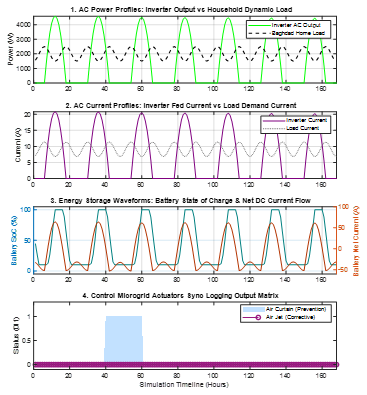
In arid regions, such as Baghdad, Iraq, where humidity varies daily and is often accompanied by dust storms, soiling is a significant environmental and operational challenge that affects PV module efficiency. This study builds a fully dynamic power-flow simulation of a 10 x 600W monofacial solar photovoltaic array solar microgrid with a 6 kW capacity. It is coupled with a 5kW grid-tied inverter and a 10 kWh lithium-ion battery storage system. In this study, the aim is to develop a dual-stage control logic loop for a microclimate conditioning system. Only a 600W air-jet purging pulse is sent in case of PV power loss of more than 15% and relative humidity less than 55%, and only a 45W low-pressure radial air curtain is used for protection in severe sandstorms. This helps to reduce the chances of dust cementation and mud formation as a result of morning dew in the area. MATLAB was used to simulate the entire microgrid for 168 hours. Statistical results showed that the inverter power clipping was effective, and the energy storage system surplus generated by inverters was turned into a sustainable final state of charge (SoC) of 86.5%. The required aerodynamic actuators were 1.50 kWh, which accounted for 0.87% of the total AC power of the inverter. The control system contributed to a net positive energy recovery, which increased system efficiency by 18.2% over a traditional blind cleaning strategy that operates during high-humidity periods. The results show a techno-energetic assessment of a sustainable and waterless cleaning system suitable for smart microgrids in central Iraq with a frictionless system.
References
A. Sayyah, M. N. Horenstein, and M. K. Mazumder, “Energy yield loss caused by dust deposition on photovoltaic panels,” Solar Energy, vol. 107, pp. 576–604, 2014, https://www.doi.org/10.1016/j.solener.2014.05.030.
A. A. Kazem, M. T. Chaichan, and H. A. Kazem, “Dust effect on photovoltaic utilization in Iraq: Review article,” Renewable and Sustainable Energy Reviews, vol. 37, pp. 734–749, 2014, https://www.doi.org/10.1016/j.rser.2014.05.073.
M. J. Alshareef, “A Comprehensive Review of the Soiling Effects on PV Module Performance,” IEEE Access, vol. 11, pp. 134623–134651, 2023, https://www.doi.org/10.1109/ACCESS.2023.3337204.
M. Mani and R. Pillai, “Impact of dust on solar photovoltaic (PV) performance: Research status, challenges and recommendations,” Renewable and Sustainable Energy Reviews, vol. 14, no. 9, pp. 3124–3131, 2010, https://www.doi.org/10.1016/j.rser.2010.07.065.
D. Mwebe, V. H. Udoka Eze, and B. Olaniyi Sadiq, “Impact of dust accumulation on solar photovoltaic panel performance and the efficacy of cleaning methods: A review of technological innovations and regional considerations,” KIU journal of science engineering and technology, vol. 4, no. 1, pp. 242–261, 2025, https://www.doi.org/10.59568/kjset-2025-4-1-24.
R. J. K. Wood and D. W. Wheeler, “Design and performance of a high velocity air-sand jet impingement erosion facility,” Wear, vol. 220, no. 2, pp. 95–112, 1998, https://www.doi.org/10.1016/S0043-1648(98)00196-3.
A. A. Q. Hasan et al., “A review on silicon photovoltaic module degradations and recent identification techniques,” Solar Energy, vol. 288, p. 113288, 2025, https://www.doi.org/10.1016/j.solener.2025.113288.
S. Mekhilef, R. Saidur, and M. Kamalisarvestani, “Effect of dust, humidity and air velocity on efficiency of photovoltaic cells,” Renewable and Sustainable Energy Reviews, vol. 16, no. 5, pp. 2920–2925, 2012, https://www.doi.org/10.1016/j.rser.2012.02.012.
N. Sakarapunthip, T. Chenvidhya, D. Chenvidhya, Y. Sangpongsanont, K. Kirtikara, and S. Chuangchote, “Characteristics, compositions, and effects of dust accumulated on PV panels in tropical agricultural area,” Japanese Journal of Applied Physics, Part 1: Regular Papers and Short Notes and Review Papers, vol. 64, no. 6, p. 06SP16, 2025, https://www.doi.org/10.35848/1347-4065/addb54.
S. Szabó et al., “A methodology for maximizing the benefits of solar landfills on closed sites,” Renewable and Sustainable Energy Reviews, vol. 76, pp. 1291–1300, 2017, https://www.doi.org/10.1016/j.rser.2017.03.117.
A. Al Mansur, J. Akhter, T. Rahman, M. I. Islam, and M. Sahin, “Optimizing PV Module Efficiency: Investigating the impact of Dry and Wet Dust on Solar Panel Output Power,” GUB Journal of Science and Engineering, vol. 10, no. 1, pp. 68–74, 2024, https://www.doi.org/10.3329/gubjse.v10i1.74947.
M. A. Ul Haq, A. Al Mansur, S. Ghosh, M. Shamim, and M. R. I. Sheikh, “An Experimental Investigation of the Impact of Dust Deposition Density and Uniformity on Photovoltaic Module Output Performance,” in Proceedings - 6th International Conference on Electrical Engineering and Information and Communication Technology, ICEEICT 2024, IEEE, pp. 324–328, 2024, https://www.doi.org/10.1109/ICEEICT62016.2024.10534536.
T. Sun, J. Hu, W. Li, and L. Gao, “Research Progress and Development Trends in Photovoltaic Desertification Control and Photovoltaic Dust Removal Technologies,” Journal of Emerging Science and Engineering, vol. 4, no. 2, p. e74, 2026, https://www.doi.org/10.61435/jese.2026.e74.
B. Huang, Y. Zhang, C. Ji, and M. Tan, “An Integrated Review of Industrial Dust Monitoring, Removal Mechanisms, Dust Collectors, and System Optimization,” Applied Sciences (Switzerland), vol. 16, no. 13, p. 6806, 2026, https://www.doi.org/10.3390/app16136806.
A. Shariah and E. A. Al-Ibrahim, “Impact of Dust and Shade on Solar Panel Efficiency and Development of a Simple Method for Measuring the Impact of Dust,” Journal of Sustainable Development of Energy, Water and Environment Systems, vol. 11, no. 2, pp. 1–14, 2023, https://www.doi.org/10.13044/j.sdewes.d11.0448.
F. M. Oleiwi, J. O. Dahloos, and H. F. Abd Ali, “Performance Analysis of 1 Mw Grid-Connected Photovoltaic System for Three Different Environments in Southwest Baghdad by Using Pv-System Software,” Paliva, vol. 16, no. 4, pp. 142–148, 2024, https://www.doi.org/10.35933/paliva.2024.04.05.
C. M. Nkinyam, C. O. Ujah, K. C. Nnakwo, O. Ezeudu, D. V. V. Kallon, and I. Ike-Eze C. Ezema, “Design and implementation of a waterless solar panel cleaning system,” Unconventional Resources, vol. 5, p. 100131, 2025, https://www.doi.org/10.1016/j.uncres.2024.100131.
F. M. Oleiwi, J. O. Dahloos, A. R. Kalash, H. A. Abdul Wahhab, and M. T. Chaichan, “Solar Photovoltaic System as a Sustainable Solution for Electric Load Shortage in Baghdad: A Design and Economic Study,” Energy Engineering: Journal of the Association of Energy Engineering, vol. 123, no. 2, 2026, https://www.doi.org/10.32604/ee.2025.073313.
Global Solar Atlas, “Solar resource data and (GIS) data: Baghdad, Iraq (Lat: 33.311, Long: 44.447).” 2021, https://www.doi.org/10.18356/g2g11584-en.
National Aeronautics and Space Administration, “Prediction of Worldwide Energy Resources (POWER) database: Climatology resource parameters for University of Technology location, Baghdad, Iraq.” 2023, https://www.earthdata.nasa.gov/data/projects/power.
K. Tifidat and N. Maouhoub, “An efficient method for predicting PV modules performance based on the two-diode model and adaptable to the single-diode model,” Renewable Energy, vol. 216, p. 119102, 2023, https://www.doi.org/10.1016/j.renene.2023.119102.
A. Sakhare and S. Mikkili, “Enhancing photovoltaic array performance through the integration of perturb and observe MPPT and novel ladder configuration,” e-Prime - Advances in Electrical Engineering, Electronics and Energy, vol. 11, p. 100943, 2025, https://www.doi.org/10.1016/j.prime.2025.100943.
Y. Li, Three dimensional solar cells based on optical confinement geometries. Springer Science & Business Media, 2013, http://scholar.google.com/scholar?hl=en&btnG=Search&q=intitle:No+Title#0.
.M. A. Green et al., “Solar cell efficiency tables (Version 64),” Progress in Photovoltaics: Research and Applications, vol. 32, no. 7, pp. 425–441, 2024, https://www.doi.org/10.1002/pip.3831.
S. H. Serbaya, “The impact of renewable and sustainable energy adoption on organizational development in small-to-medium enterprises (SMEs),” Sustainable Computing: Informatics and Systems, vol. 51, p. 101379, 2026, https://www.doi.org/10.1016/j.suscom.2026.101379.
Z. Alaas, Z. M. S. Elbarbary, A. Rezvani, B. N. Le, and M. khaki, “Analysis and enhancement of MPPT technique to increase accuracy and speed in photovoltaic systems under different conditions,” Optik, vol. 289, p. 171208, 2023, https://www.doi.org/10.1016/j.ijleo.2023.171208.
D. Q. Oliveira et al., “A critical review of energy storage technologies for microgrids,” Energy Systems, vol. 16, no. 3, pp. 1063–1092, 2025, https://www.doi.org/10.1007/s12667-021-00464-6.
X. Tan, Q. Li, and H. Wang, “Advances and trends of energy storage technology in Microgrid,” International Journal of Electrical Power & Energy Systems, vol. 44, no. 1, pp. 179–191, Jan. 2013, https://www.doi.org/10.1016/j.ijepes.2012.07.015.
B. O. Olorunfemi, O. A. Ogbolumani, and N. Nwulu, “Solar Panels Dirt Monitoring and Cleaning for Performance Improvement: A Systematic Review on Smart Systems,” Sustainability (Switzerland), vol. 14, no. 17, p. 10920, 2022, https://www.doi.org/10.3390/su141710920.
F. L. Rashid et al., “Impinging jets solar air heater: A comprehensive review of performance enhancement techniques,” Environmental Progress and Sustainable Energy, vol. 45, no. 4, p. e70408, 2026, https://www.doi.org/10.1002/ep.70408.
A. Syafiq, A. K. Pandey, and N. A. Rahim, “Photovoltaic glass cleaning methods: An overview,” in IET Conference Publications, Stevenage, UK: IET, 2016 https://www.doi.org/10.1049/cp.2016.1338.
M. Gandomzadeh et al., “Dust mitigation methods and multi-criteria decision-making cleaning strategies for photovoltaic systems: Advances, challenges, and future directions,” Energy Strategy Reviews, vol. 57, p. 101629, 2025, https://www.doi.org/10.1016/j.esr.2024.101629.
NASA, “Prediction of Worldwide Energy Resources (POWER) Project,” NASA Langley Research Center. 2026. https://www.doi.org/10.5067/POWER/SOLAR/MONTHLY/001.
F. Zaoui, R. Khenfer, A. Lekbir, S. Mekhilef, and Z. Rouabah, “Mitigation of Soiling and Assessment of PV Module Performance under IEC 60891 by Based-Brush and Based-Water Cleaning Methods Using,” Applied Solar Energy (English translation of Geliotekhnika), vol. 60, no. 2, pp. 226–241, 2024, https://www.doi.org/10.3103/S0003701X23601758.
M. King et al., “Mathematical modelling of a system for solar pv efficiency improvement using compressed air for panel cleaning and cooling,” Energies, vol. 14, no. 14, p. 4072, 2021, https://www.doi.org/10.3390/en14144072.
J. Eiche, O. O, Bamidele, E. A., Fadiji, and T. S, Mogaji, “Design and Construction of an Automatic Solar Panel Cleaning System,” Saudi Journal of Engineering and Technology, vol. 8, no. 12, pp. 293–299, 2023, https://www.doi.org/10.36348/sjet.2023.v08i12.001.
Published
How to Cite
Issue
Section
License
Copyright (c) 2026 Fadhil Mahmood Oleiwia, Salam Waley Shneen

This work is licensed under a Creative Commons Attribution-ShareAlike 4.0 International License.

This journal is licensed under a Creative Commons Attribution-ShareAlike 4.0 International License.
