Driver Drowsiness Detection and Warning System Using Computer Vision and Neural Networks on Embedded Platforms
DOI:
https://doi.org/10.59247/jfsc.v4i2.372Keywords:
Driver Fatigue Detection, Computer Vision, EAR, Deep Learning, Embedded Systems, Raspberry Pi, Neural NetworksAbstract
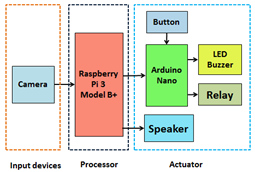
Driver drowsiness is one of the leading causes of traffic accidents worldwide. Traditional monitoring approaches, such as vehicle-based parameter analysis or physiological signal measurement, often require intrusive sensors or deep access to vehicle systems. To overcome these limitations, this paper proposes a real-time driver drowsiness detection and warning system using computer vision combined with a neural network classifier on an embedded platform. Facial landmarks are extracted using the dlib 68-point model, and the Eye Aspect Ratio (EAR) is computed to evaluate eye-closure behavior. A deep neural classifier is trained on eye-state and temporal EAR sequences collected from 25 subjects to classify normal and drowsy conditions. The system is deployed on a Raspberry Pi 3 B+ embedded platform, integrated with an Arduino-based alarm module to deliver audio–visual alerts when drowsiness is detected. Experimental results demonstrate a training accuracy of 98.4% and a testing accuracy of 92.8% with real-time performance of 15–20 FPS under daylight conditions, stable performance in real time, and feasibility for installation in passenger cars, trucks, and buses. The proposed method contributes a low-cost, efficient, and deployable solution for reducing road accidents with a focus on lightweight embedded implementation.
References
Y. Albadawi, M. Takruri, and M. Awad, “A Review of Recent Developments in Driver Drowsiness Detection Systems,” Sensors, vol. 22, no. 5, p. 2069, 2022, https://doi.org/10.3390/s22052069.
A. Sahayadhas, K. Sundaraj, and M. Murugappan, “Detecting driver drowsiness based on sensors: A review,” Sensors (Switzerland), vol. 12, no. 12, pp. 16937–16953, 2012, https://doi.org/10.3390/s121216937.
P. Sowmyashree and J. Sangeetha, “Driver Drowsiness Detection System Based on Behavioral Method, Biological Method and Vehicular Feature-Based Method—A Review,” Smart Innovation, Systems and Technologies, vol. 363, no. 2, pp. 125–134, 2023, https://doi.org/10.1007/978-981-99-4717-1_12.
Q. Ji, Z. Zhu, and P. Lan, “Real-time nonintrusive monitoring and prediction of driver fatigue,” IEEE Transactions on Vehicular Technology, vol. 53, no. 4, pp. 1052–1068, 2004, https://doi.org/10.1109/TVT.2004.830974.
B. K. Reddy, P. S. Jayanth, and M. Subramaniam, “Driver Drowsiness Detection Using CNN and LSTM,” in 2025 2nd International Conference on Computing and Data Science, ICCDS 2025, 2025 https://doi.org/10.1109/ICCDS64403.2025.11209635.
C. Dewi, R. C. Chen, C. W. Chang, S. H. Wu, X. Jiang, and H. Yu, “Eye Aspect Ratio for Real-Time Drowsiness Detection to Improve Driver Safety,” Electronics (Switzerland), vol. 11, no. 19, p. 3183, 2022, https://doi.org/10.3390/electronics11193183.
Y. H. Huang, M. Ho, G. S. Smith, and P. Y. Chen, “Safety climate and self-reported injury: Assessing the mediating role of employee safety control,” Accident Analysis and Prevention, vol. 38, no. 3, pp. 425–433, 2006, https://doi.org/10.1016/j.aap.2005.07.002.
J. W. Lee, S. K. Lee, C. H. Kim, K. H. Kim, and O. C. Kwon, “Detection of drowsy driving based on driving information,” International Conference on ICT Convergence, vol. 14, no. 4, pp. 607–608, 2014, https://doi.org/10.1109/ICTC.2014.6983224.
V. Maglogiannis, D. Naudts, A. Shahid, S. Giannoulis, E. Laermans, and I. Moerman, “Cooperation techniques between LTE in unlicensed spectrum and Wi-Fi towards fair spectral efficiency,” Sensors (Switzerland), vol. 17, no. 9, 2017, https://doi.org/10.3390/s17091994.
A. Poschinger, M. Cremer, and H. Keller, “A control scheme for variable direction signs using dynamic reference values,” in Proceedings of Conference on Intelligent Transportation Systems, IEEE, pp. 278–283, 1997, https://doi.org/10.1109/ITSC.1997.660488.
Y. Zhang and C. Hua, “Driver fatigue recognition based on facial expression analysis using local binary patterns,” Optik, vol. 126, no. 23, pp. 4501–4505, 2015, https://doi.org/10.1016/j.ijleo.2015.08.185.
R. Florez, F. Palomino-Quispe, A. B. Alvarez, R. J. Coaquira-Castillo, and J. C. Herrera-Levano, “A real-time embedded system for driver drowsiness detection based on visual analysis of the eyes and mouth using convolutional neural network and mouth aspect ratio,” Sensors, vol. 24, no. 19, p. 6261, 2024, https://doi.org/10.3390/s24196261.
C. Dewi, R. C. Chen, C. W. Chang, S. H. Wu, X. Jiang, and H. Yu, “Eye Aspect Ratio for Real-Time Drowsiness Detection to Improve Driver Safety,” Electronics (Switzerland), vol. 11, no. 19, p. 3183, 2022, https://doi.org/10.3390/electronics11193183.
N. Thaker and A. Shukla, “Python as Multi Paradigm Programming Language,” International Journal of Computer Applications, vol. 177, no. 31, pp. 38–42, 2020, https://doi.org/10.5120/ijca2020919775.
N. Dardagan, A. Brdanin, D. Dzigal, and A. Akagic, “Multiple object trackers in OpenCV: A benchmark,” in 2021 IEEE 30th International Symposium on Industrial Electronics (ISIE), Sebastopol, CA, USA: IEEE, pp. 1–6, 2021, https://doi.org/10.1109/ISIE45552.2021.9576367.
V. Kazemi and J. Sullivan, “One millisecond face alignment with an ensemble of regression trees,” in Proceedings of the IEEE Computer Society Conference on Computer Vision and Pattern Recognition, pp. 1867–1874, 2014, https://doi.org/10.1109/CVPR.2014.241.
M. Z. Liu, X. Xu, J. Hu, and Q. N. Jiang, “Real time detection of driver fatigue based on CNN-LSTM,” IET Image Processing, vol. 16, no. 2, pp. 576–595, 2022, https://doi.org/10.1049/ipr2.12373.
J. Gwak, M. Shino, and A. Hirao, “Early Detection of Driver Drowsiness Utilizing Machine Learning based on Physiological Signals, Behavioral Measures, and Driving Performance,” in 2018 21st International Conference on Intelligent Transportation Systems (ITSC), IEEE, pp. 1794–1800, 2018, https://doi.org/10.1109/ITSC.2018.8569493.
Published
How to Cite
Issue
Section
License
Copyright (c) 2026 Chi-Phat Pham, Quang Tran, Binh-Hau Nguyen, Van-Dong-Hai Nguyen, Thi-Hong-Lam Le, Ngoc-Hung Nguyen, Van-Hiep Nguyen, Thanh-Binh Nguyen, Thi-Ngoc-Thao Nguyen, Hoang-Lam Le

This work is licensed under a Creative Commons Attribution-ShareAlike 4.0 International License.
