Stabilization of Double Inverted Pendulum using LQR-based Information Fusion Fuzzy Control
DOI:
https://doi.org/10.59247/jfsc.v4i2.370Keywords:
DIPC, Fuzzy Logic Control, Information Fusion, LQR, SIMO System, Forward KinematicsAbstract
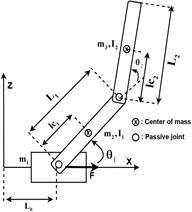
Modeling the six-state Double Inverted Pendulum on Cart (DIPC) is highly challenging due to its strong nonlinearities and underactuated dynamics. To address this, the system model in this study is derived using a systematic forward-kinematics-based formulation from robotics theory, previously validated for accuracy in both LQR experiments and ANFIS simulations reported in earlier work. Building on this validated foundation, the present study proposes an Information Fusion Fuzzy Logic Controller (IF-FLC) to overcome the curse of dimensionality commonly encountered when designing fuzzy controllers for high-order systems. The method compresses the six measured state variables into two synthesized linguistic inputs—Synthesized Error (E) and Error Change (EC)—allowing the construction of an efficient 49-rule fuzzy controller without compromising essential system dynamics. Simulations incorporating encoder quantization and realistic measurement constraints show that the proposed IF-FLC provides stable balancing performance and improved robustness compared with the LQR benchmark. The results indicate that information-fusion-based fuzzy design is a promising approach for reducing controller complexity while maintaining high performance, offering a practical pathway for implementing intelligent control strategies on nonlinear and underactuated systems such as the DIPC.
References
O. Boubaker, “The inverted pendulum benchmark in nonlinear control theory: A survey,” in International Journal of Advanced Robotic Systems, vol. 10, InTechOpen, 2013, https://doi.org/10.5772/55058.
K. H. Lundberg and T. W. Barton, “History of inverted-pendulum systems,” IFAC Proceedings Volumes (IFAC-PapersOnline), vol. 8, no. PART 1, pp. 131–135, 2009, https://doi.org/10.3182/20091021-3-jp-2009.00025.
T. Zielinska, G. R. R. Coba, and W. Ge, “Variable Inverted Pendulum Applied to Humanoid Motion Design,” Robotica, vol. 39, no. 8, pp. 1368–1389, 2021, https://doi.org/10.1017/S0263574720001228.
S. Singh and J. Heard, “Human-Aware Reinforcement Learning for Adaptive Human Robot Teaming,” in ACM/IEEE International Conference on Human-Robot Interaction, Sapporo, Japan, pp. 1049–1052, 2022, https://doi.org/10.1109/HRI53351.2022.9889530.
A. Hooshiar, “Stabilization of Double Inverted Pendulum on Cart: LQR Approach,” in International Journal of Mechanical and Production Engineering, Bangkok, Thailand, pp. 2320–2092, 2017, http://iraj.in.
T. Le, N. Nguyen, P. Le, M. Bui, T. Nguyen, and C. Tran, “LQR Controller Based on BAT Algorithm for Rotary Double Parallel Inverted Pendulum,” Journal of Fuzzy Systems and Control, vol. 3, no. 2, pp. 112–121, 2025, https://doi.org/10.59247/jfsc.v3i2.304.
M. Alsheikh, L. Elkhider, and A. W. A. Saif, “Optimal Control and Balancing of Double Inverted Pendulum using Linear Quadratic and Model Predictive Controller,” in 2023 20th International Multi-Conference on Systems, Signals and Devices, SSD 2023, Mahdia, Tunisia, pp. 509–513, 2023, https://doi.org/10.1109/SSD58187.2023.10411273.
E. Shala, X. Bajrami, R. Likaj, and A. Pajaziti, “Real Time Swinging Up and Stabilizing a Double Inverted Pendulum Using Pid-Lqr,” Strojnicky Casopis, vol. 73, no. 1, pp. 159–168, 2023, https://doi.org/10.2478/scjme-2023-0013.
N.-C. Tran et al., “LQR Control for Experimental Double Rotary Inverted Pendulum,” Journal of Fuzzy Systems and Control, vol. 2, no. 2, pp. 104–108, 2024, https://doi.org/10.59247/jfsc.v2i2.212.
H. Han, C. Y. Su, and Y. Stepanenko, “Adaptive control of a class of nonlinear systems with nonlinearly parameterized fuzzy approximators,” IEEE Transactions on Fuzzy Systems, vol. 9, no. 2, pp. 315–323, 2001, https://doi.org/10.1109/91.919252.
H. H. Tang and N. S. Ahmad, “Fuzzy logic approach for controlling uncertain and nonlinear systems: a comprehensive review of applications and advances,” Systems Science and Control Engineering, vol. 12, no. 1, 2024, https://doi.org/10.1080/21642583.2024.2394429.
R. K. Mudi and N. R. Pal, “A robust self-tuning scheme for PI- and PD-type fuzzy controllers,” IEEE Transactions on Fuzzy Systems, vol. 7, no. 1, pp. 2–16, Feb. 1999, https://doi.org/10.1109/91.746295.
C.-H. Nguyen et al., “ANFIS-based LQR control for rotary double parallel inverted pendulum,” Journal of Fuzzy Systems and Control, vol. 2, no. 2, pp. 109–116, 2024, https://doi.org/10.59247/jfsc.v2i2.214.
J. S. R. Jang, “ANFIS: Adaptive-Network-Based Fuzzy Inference System,” IEEE Transactions on Systems, Man and Cybernetics, vol. 23, no. 3, pp. 665–685, 1993, https://doi.org/10.1109/21.256541.
L. Wang, S. Zheng, X. Wang, and L. Fan, “Fuzzy control of a double inverted pendulum based on information fusion,” in Proceedings of 2010 International Conference on Intelligent Control and Information Processing, ICICIP 2010, Dalian, China, pp. 327–331, 2010, https://doi.org/10.1109/ICICIP.2010.5564318.
J. Baillieul, Introduction to ROBOTICS mechanics and control, 3rd ed., vol. 32, no. 5. Upper Saddle River, NJ, USA: Pearson Education, 2004. https://doi.org/10.1109/tac.1987.1104613.
T.-P.-N. Pham et al., “An LQR-Based ANFIS Control for Double-Linked Inverted Pendulum on Cart,” Journal of Fuzzy Systems and Control, vol. 3, no. 2, pp. 135–141, 2025, https://doi.org/https://doi.org/10.59247/jfsc.v3i2.307.
T.-P.-N. Pham et al., “Experimental LQR-Based ANFIS Control for Double-Linked Inverted Pendulum on Cart,” Robotica & Management, vol. 30, no. 2, pp. 33–38, 2025, https://doi.org/10.24193/rm.2025.2.6.
Published
How to Cite
Issue
Section
License
Copyright (c) 2026 Truong-Phuong-Nam Pham, Le-Thao-Nguyen Nguyen, TrongBang Tran, Dai-An Ly, Anh-Phong Nguyen, Van-Tung Dau, Nhut-Nam Nguyen, Ba-Thien Tran, Tri-Bao Tran, Dinh-Binh Vo, Van-Duc Nguyen, Thi-Ngoc-Thao Nguyen, Thanh-Tung Nguyen

This work is licensed under a Creative Commons Attribution-ShareAlike 4.0 International License.
